
Dividing, an innocent step?
Cut without betraying: the paradox of volume and weight
Bulk fermentation is complete. The mass is full of gas, structured, alive. The first gesture inflicted on it is not innocent: dividing means slicing through a network that took hours to build, and it's also — often forgotten — the moment when the weight regularity of the entire batch is determined.
Division seems trivial: cut the mass into pieces of equal weight. In reality, two problems overlap. A mechanical problem — the cut wounds the gluten. And a deeper physical problem — density: conventional dividers (hydraulic or volumetric) never measure weight, they measure volume. But weight is what the baker sells.
1 - THE FOUNDING PARADOX: VOLUME VERSUS WEIGHT
Conventional dividers cut dough by volume: a chamber of fixed capacity, filled then sectioned. But the baker reasons in mass. And the two are linked by a single relationship:
MASS = DENSITY × VOLUME (M = ρ × V)
The trap is there: during fermentation, dough fills with CO₂, so its density ρ continuously drops. At constant chamber volume, the more gassed the dough, the lighter the piece. A mass that stays full of gas waiting for division will produce heavier first pieces than last ones. Weight drift is not a machine defect, it's an inevitable physical consequence whenever you divide by volume a material whose density shifts or isn't uniform. All the art of dividing is to neutralize this drift: divide quickly, at a controlled fermentation point, at density as stable as possible.
Designing a divider means first solving an engineer's dilemma: divide by the dimensions of a dough volume, or by its weight. The two are physically irreconcilable — a chamber cannot measure both a fixed volume and a fixed mass on dough whose density moves. You must choose. Volume division is the simplest and cheapest: it's what the market largely proposes. Weight division is significantly more technical, and MERAND is among the rare few who know how to master it.
2 - THE GLUTEN NETWORK AND THE CLEAN CUT
Dividing means sectioning the gluten network. Each cut breaks chains, locally releases gas, and creates weakened edges. A clean, sharp shear cleanly slices the network; a dull or sticky blade tears instead of cutting, leaving ragged edges that will reseal poorly and lose more gas. The physical rule boils down to one sentence: fewer cuts, sharper cuts = less damage. On high-hydration dough, where gluten is most fragile, poorly-controlled pressure tears the dough instead of cutting it.
3 - PRESSURE, VISCOELASTICITY, AND THE RISK OF RUPTURE
Piston or hydraulic dividers press dough into a chamber before cutting. This compression degasses, useful for fixing volume, but double-edged. Dough is viscoelastic: under pressure, it responds partly elastically (it absorbs and rebounds) and partly viscously (it deforms permanently). Excessive or too-brutal pressure exceeds the network's bearing capacity and breaks it, exactly like localized overmixing. That's why hydraulic dividers equipped with a pressure regulator better preserve alveolar structure: they fix volume without battering the structure.
COMPRESSION → ELASTIC RESPONSE (RECOVERY) + VISCOUS CREEP (FIXATION) + RUPTURE IF EXCESSIVE
4 - CADENCE AND FERMENTATION DRIFT
In the divider, dough continues to ferment: each minute of wait further lowers density, so the weight of following pieces. The more the divider's throughput is misaligned with the rest of the line, the longer the queue, the larger the drift amplifies. Add to this, on fast continuous dividers, a friction heating that locally speeds fermentation. Weight regularity is also a matter of matched cadence: divide at the rate the dough arrives, without building waiting stock.
5 - PRECISION AND THE ECONOMICS OF SCATTER
No conventional divider is perfect: piece weights distribute around an average with standard deviation σ (the scatter). Since the baker must guarantee a minimum weight and never fall below, they target an average above that minimum, with a safety margin proportional to σ:
TARGET WEIGHT = GUARANTEED WEIGHT + σ × z
where z sets the safety level — for ~99.5% of pieces to exceed the minimum, z ≈ 2.6. All the economic consequence is right there: reducing σ means reducing the safety overage, so the dough given free. Illustrative example on a baguette with guaranteed piece of 340g:
|
Type |
σ (Scatter) |
Target weight |
Overage "given" |
|---|---|---|---|
|
Imprecise |
9 g |
340 + 2.6×9 ≈ 363 g |
≈ 23 g/piece |
|
Precise |
1 g |
340 + 2.6×1 ≈ 343 g |
≈ 2.6 g/piece |
That's ~20 g saved per baguette. On 1,000 baguettes/day, that's ≈ 20 kg of dough per day no longer given away as overage — raw material directly transformed into margin, or 58 extra baguettes produced.
« The precision of a divider is measured in precision and comfort; it's paid for in time saved and flour economized. »
6 - DIAGNOSIS: A GOOD DIVISION
- Weight regularity: σ tight, drift controlled between first and last piece.
- Clean edges: sharp cut, piece that will retain gas, without tearing, with minimal oxidation.
- Minimal and uniform degassing: we fix the volume without emptying the dough.
- Controlled fermentation point: dough at the right point divides cleanly; over-gassed, it drifts and sticks; too young, it resists.
✦
« A divider doesn't weigh, it measures a volume and bets on density. Our job is to make that bet safe. »
PRINCIPLE OF DIVISION · MASS = DENSITY × VOLUME
Summary Table — Division
|
Parameter |
Physicochemical Effect |
Result on the Batch |
|---|---|---|
|
Volume vs density |
ρ drops during fermentation |
Weight drift (to neutralize) |
|
Clean cut |
Minimal network section |
Healthy edges, gas preserved |
|
Controlled pressure |
Viscoelastic stress without rupture |
Alveolar structure preserved |
|
Matched cadence |
Stable density, short queue |
Weight regularity |
|
Precision |
σ reduced |
Safety overage reduced |
|
Optimization |
Synchronized parameters |
Direct material economy |
ACTE 1 - LA DIVSION - APPROFONDISSEMENT
ACT 1 — DIVISION — DEEPER DIVE
Dividing into Several Pieces
When cutting means reworking the dough
We think dividing only separates. In reality, the more you fractionate a mass, and especially the more you press it to do so, the more you rework it. And that work — the dough doesn't forget it: it reads directly on its tenacity.
- GEOMETRY
The surface-to-volume ratio, the hidden cost of fractionation
Cutting a mass in two creates two surfaces. Cutting it into twenty creates dozens. At equal mass, the more you divide, the more you multiply exposed surface, and each square centimeter of new surface is gluten network laid bare: a wounded edge that loses gas, that crusts during relaxation, and that oxidizes in contact with air. A large piece preserves its alveolar structure better than a mass chopped into multiple small pieces, simply because it offers less constraint from these edge losses. It's geometry and physics.
- RHEOLOGY
The real culprit behind tenacity: pressure, not the cut
A rigorous and counter-intuitive point: it's not the shearing that makes dough tenacious, it's the compression used to fractionate. Hydraulic dividers that cut into several pieces by pressing a block through a grid apply mechanical work that acts like a mini-mix: glutenin chains draw together and realign, and in the presence of incorporated air, new inter-chain disulfide bridges (–S–S–) form. The network densifies, tightens. Measurable result on the alveograph:
PRESSURE → MECHANICAL WORK → ALIGNMENT + –S–S– BONDS → P ↑ · L ↓ · P/L ↑
Tenacity (P) rises, extensibility (L) falls, P/L ratio climbs. A dough that left the mixer perfectly balanced can find itself, after severe pressure division, firmed up and tense, as if it had been locally over-mixed. And the more pieces you make, the more you multiply cycles of pressure and shear: the effect is cumulative.
- CONSEQUENCES
What it costs downstream
A dough whose division has raised tenacity takes its revenge throughout the line. At shaping, it resists elongation, retracts under the rollers (exacerbated elastic memory); baguettes shorten after lengthening and must be retouched. At relaxation, it takes more time to release this added tension. In the oven, the over-tenacious piece takes less volume and produces a tighter crumb. And on grid division, if the divider is poorly designed, pressure never being perfectly uniform, edge and center pieces don't receive the same work: you harvest variability not only in weight, but in rheology between pieces of the same batch.
- STRATEGY
Le niveau de stress décide de tout
The level of stress decides everything
The true lever isn't the number of pieces per se, but the way to obtain them. The idea is to adapt your strategy based on the production volume you need and the investment level you want to put into it.
Broadly, depending on whether you divide manually, with a hydraulic or volumetric divider, you must then adapt your baking method to correct the defects produced at this step.
All the tenacity added by brutal division is additional elastic stress to release. That's precisely what the next step, Relaxation, must untangle. Better to be as respectful as possible of the dough.
Every divider manufacturer faces the same choice: calibrate the cut to the dimensions of a volume, or to the actual weight of the piece. You cannot do both. Nearly the entire market chose volume: simpler, cheaper.
MERAND Mécapâte made the other choice, the most demanding one: divide by weight with the RheoPan Precision.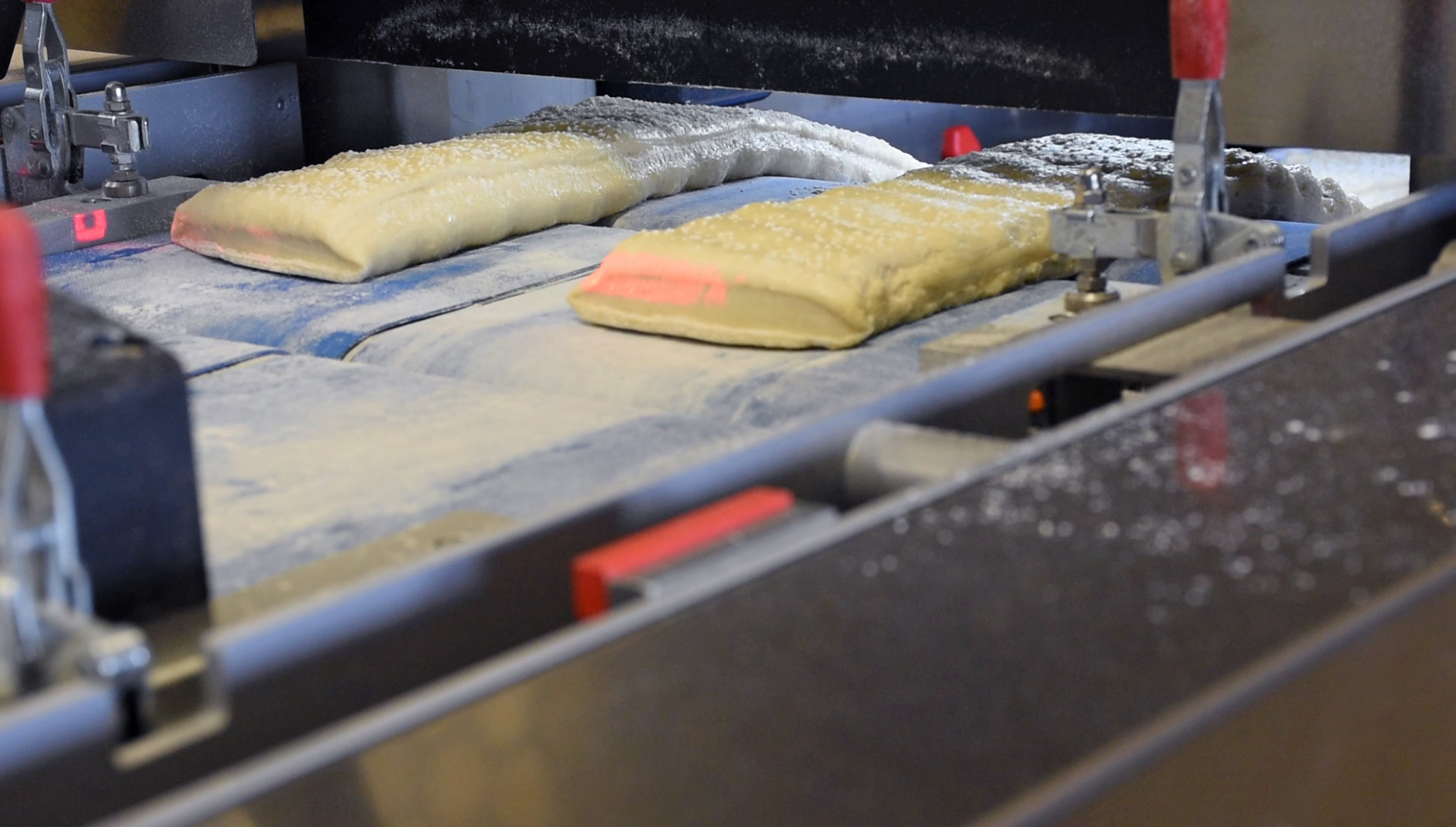
TECHNICAL APPLICATION
Why the RheoPan Precision
Everything you've just read — the volume/weight paradox, density drift, network wounding, the statistical cost of overage, the tenacity added by pressure — these are exactly the constraints the RheoPan Precision divider responds to. Not with a promise, but with a system.
IT WEIGHS, IT DOESN'T BET DOUBLE-WEIGHING & CONSTANT READJUSTMENT
Weight held from first to last piece
A conventional volumetric divider fixes a volume and suffers density drift: first pieces heavy, last pieces light. The RheoPan weighs pieces and automatically adjusts its settings, with constant readjustment of weight division. It continuously neutralizes the drop in density: target weight stays held from first to last piece. This is what tightens the standard deviation σ — surplus overage suppressed, so flour that stays as margin.
WITHOUT STRESS — STRUCTURE PRESERVED
Divide without reworking the dough
Its stress-free division system handles highly hydrated or fermented doughs as well as stiff doughs. This is the answer to viscoelastic stress: we fix the volume without battering the network, and without the compression work that raises tenacity. The P/L balance set during mixing and bulk fermentation arrives intact at relaxation — no baguette that retracts because the divider gave it strength, no alveolar structure crushed on traditional doughs. Double-weighing holds the weight; stress-free holds the rheology.
CLEAN CUT — CONTROLLED GUILLOTINE & LUBRICATION
Healthy edges that reseal
The quality of the cut decides healthy edges. The RheoPan divides dough into one or two bands, then cuts thanks to its compressed-air guillotine, with a highly efficient, adjustable-flow lubrication system: sharp cut, no tearing, pieces cut in one pass that retain gas.
VERSATILITY & REPRODUCIBILITY
Regularity, batch after batch
It works in 1 or 2 bands and memorizes parameters for 50 recipes through its touch screen: weight regularity becomes reproducible from batch to batch, not just on lucky days. And it maintains steady cadence, up to 850 kg dough/hour depending on model.
The RheoPan Precision doesn't just measure a volume by betting on density: it weighs, it compares, it corrects. The bet becomes certainty — and the scale proves it before even the oven.
AT MERAND Mécapâte, OUR COMPLETE RANGE
Each dough, its divider
The RheoPan Precision is our stress-free reference. But it's not the only good answer. The best divider doesn't exist in absolute terms: it depends on your production volume, your bread range, and your investment level. Point of honesty: a well-designed hydraulic or volumetric divider doesn't suffer the defects described above — it corrects them through engineering.
THE HYDRAULIC PATH — DIVA · DIV'X · ATOUPAINS
The versatility of craft, the mastered gesture
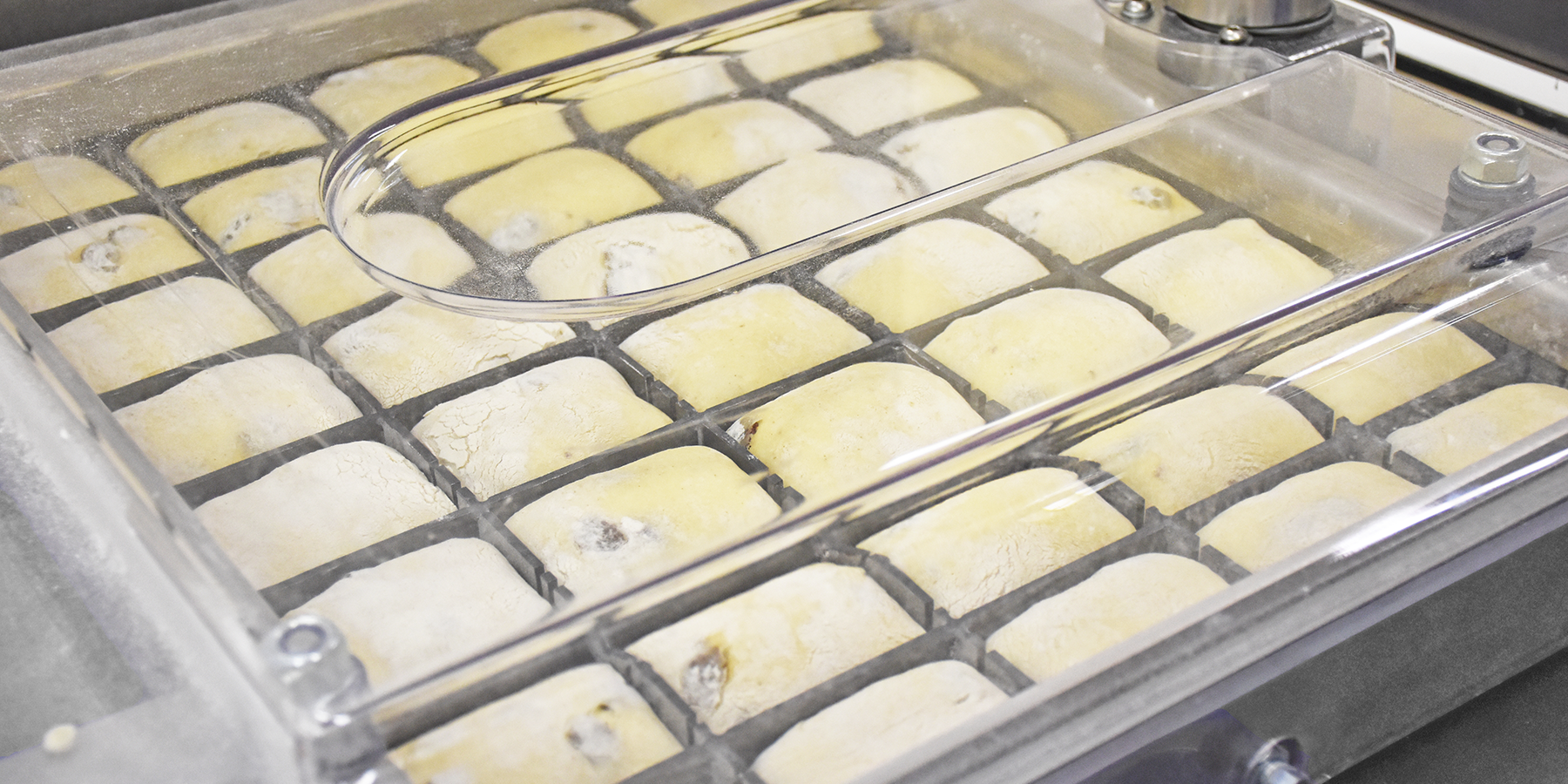
For the baker who divides then reworks, the DIVA shares the bowl (round or square) into 20 pieces up to 1 kg (from 150 to 1,000 g) — it's basic, reliable division. The Div'X goes further: thanks to its adaptable grids, it even divides pre-fermented doughs and outputs pieces ready to bake (Traditional, rustic squares, ciabatta, small rolls) — so fewer downstream manipulations, so less degassing. The Atoupains, finally, has built its reputation on its innovative hydraulic system and its AlvéoForm system: no more cutting marks, it comes to pinch the dough. Beautiful well-shaped baguettes, with round or square ends. It's the direct answer to the "wound and ragged edges" defect: pressure is regulated, and AlvéoForm forms baguettes cleanly. The stress described above isn't an inevitability of hydraulics — it's a matter of design.
THE VOLUMETRIC PATH — SOFTY · LOFTY
Throughput that kills drift
To feed a line or produce in volume, cadence is the weapon against density drift. The Lofty divides bread and baguettes up to 2,400 pieces/h, and comes in several hopper sizes: from craft to semi-industrial to fit your production, not the other way around. This throughput isn't a floor: the 2,400 pieces/h corresponds to maximum continuous operation, but cadence adjusts and the machine pauses as simply as it restarts — you divide at the real rhythm of the bakery, never suffering the cadence. The large hopper, when chosen, answers the problem of "drift in the queue": you dump an entire mixer and divide fast, the dough doesn't have time to lose its density. The Lofty, like the Softy, are at the base of most MERAND Mécapâte automatic lines.
Throughput is the weapon against drift.
Three technologies, three playing fields
|
Technology |
Playing Field |
MERAND Advantage |
Models |
|---|---|---|---|
|
Hydraulic |
Craft · shape versatility |
Regulated pressure + AlvéoForm (zero marks) |
DIVA · Div'X · Atoupains |
|
Volumetric |
High throughput |
Large hopper + cadence → drift minimized |
Softy · Lofty |
|
Stress Free |
Productivity and hyper quality |
Double-weighing + zero stress |
RheoPan Precision |
The right choice isn't "the best machine," but "the right machine for your production." At MERAND Mécapâte, each is designed to minimize the compromise inherent to its technology.
✦
"Our machines are designed by bakers, for bakers."
Visit us!
We welcome you to our BakingLab® to test our machines. Bring your flour, bring your questions, we'll bring everything else.
Next episode:
Relaxation: time as a tool
Why a piece isn't shaped right away