
The Proofing: Time as a Tool
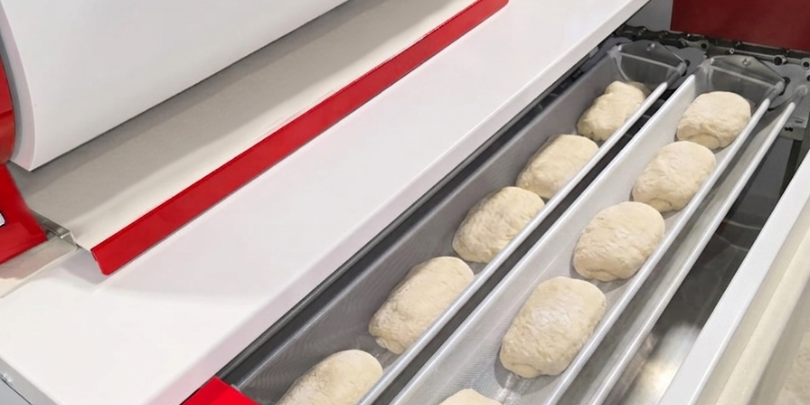
Why a Dough Piece Should Not Be Shaped Immediately
Division has just stressed the dough: it was cut, sometimes pressed, and then forced into a shape. Its network is under tension. The instinct would be to move straight to shaping—and that's the mistake. Here, the baker's most technical skill is to wait. But waiting in baking has never meant doing nothing: during proofing, the dough executes a precise sequence of physical and chemical reactions on its own. What matters is knowing which ones, and when to stop them.
1 – THE PRINCIPLE : Dough Has Two Clocks
Everything in this phase stems from a single property: gluten is viscoelastic. It behaves simultaneously as an elastic solid and as a viscous liquid: two behaviors, two clocks.
The elastic clock, carried by glutenins, is the spring: it stores the energy imposed on it and wants to return to its initial state. That's memory. The viscous clock, carried by gliadins, is flow: it dissipates energy and locks in the deformation. That's creep.
Shaping and proofing are nothing more than playing these two clocks against each other. Shaping loads the spring (we store elastic tension). Proofing lets the viscous overtake the elastic (tension dissipates, memory fades). Holding this thread is understanding the entire phase.
DEFORMATION → STORED ELASTIC ENERGY (MEMORY) + VISCOUS CREEP (DISSIPATION)
2 – SHAPING: Imposing Oriented Deformation
A dough piece fresh from division is formless and anisotropic: no defined shape, disordered network, tensions concentrated at the cut edges. Shaping does two things simultaneously.
It orients the network: the long chains of glutenins, in a coiled state, align along the direction of the effort (coil state → fibrillar state, exactly as during mixing). And it loads the elastic spring: the network goes back under tension. This is where product choice matters. You pre-elongate to orient the fibers along the axis of a future baguette; you pre-round for a round shape, a short loaf, or to restore strength to a slack dough by restructuring its network. The pre-shape is not mere handling: it's the amount of elastic energy you deposit in the dough piece, which must then relax.
Calibrating this gesture is all the skill: too much tightening stores too much tension (dough piece that will take too long to relax, will resist, will tear); not enough installs no structure (soft dough piece that will spread, will not elongate properly).
FORMLESS DOUGH PIECE → ORIENTED DEFORMATION → ALIGNED NETWORK + UNDER ELASTIC TENSION
Caution : This pre-rounding is a light gesture, not to be confused with the tight rounding of final shaping, which comes after proofing—we'll return to this in the next phase.
3 – PROOFING: Relaxation and Creep
The dough piece holds its pre-shape: the deformation is maintained. Yet at constant deformation, internal stress in a viscoelastic material drops over time—this is stress relaxation. At the molecular level, weak bonds (hydrogen bonds) under tension break and reform in a less constrained configuration; the chains slip past each other through creep. The elastic energy stored during shaping dissipates: memory fades, extensibility returns, the dough piece stops trying to revert to its previous form.
In parallel, water redistributes among the dough's components: it completes hydration of the gluten and especially the pentosans, which are slowest to absorb water. This further softens the network and completes relaxation. But everything depends on hydration level: on a highly hydrated dough, components are already saturated and can absorb nothing more. The excess water, remaining free, then migrates to the surface (syneresis) and makes the dough piece sticky—all the faster the longer proofing continues.
STRESS(T) ↓ AT CONSTANT DEFORMATION → STRESS RELAXATION → MEMORY ERASED
4 – FERMENTATION REACTIONS: What Life Does to the Network
And there is a prerequisite that shaping has just triggered: by reorienting the network, pre-rounding restores strength to the dough (mechanical strength gain); and by fragmenting gas cells, it releases the accumulated CO₂ that was inhibiting the yeasts and brings them back into contact with substrate. Like a light fold during bulk fermentation, shaping restarts fermentation: the yeasts resume activity, and this renewed fermentation will work on the network during the rest.
This time is therefore not chemically neutral. Even if brief, it lets fermentation act on the network—and its action cuts both ways. 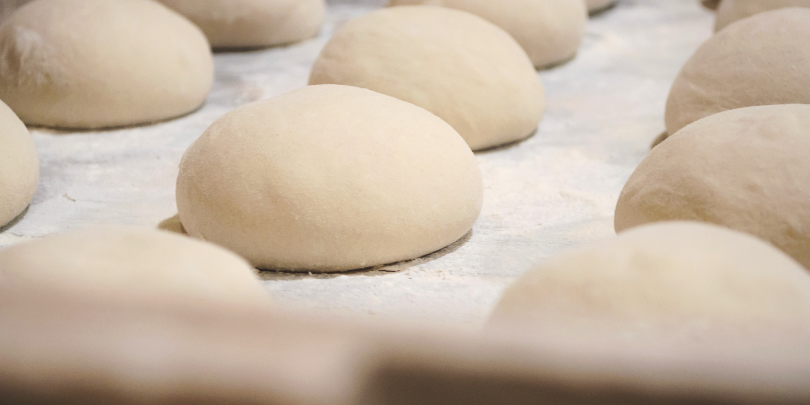
On one hand, newly produced CO₂ reinflates the alveolar nuclei: its internal pressure stretches and softens the network from within. On the other, some of this CO₂ dissolves in the aqueous phase as carbonic acid (H₂CO₃): pH begins to drop. Gluten proteins move closer to their isoelectric point, their charges neutralize, the chains draw together and structure themselves: the network tightens. This is the double game of proofing: gas softens, acid tightens. At this stage, acidification is only an initial phase—real but moderate.
CO₂ → INTERNAL PRESSURE (SOFTENS) + H₂CO₃ → pH ↓ (TIGHTENS, INITIAL) · DUAL PLAY
Add to this the enzymatic work: proteases continue light proteolysis (gluten softens, amino acids are released), amylases degrade starch into fermentable sugars that will feed what follows. And the ethanol produced acts as a light plasticizer of the network, while initiating aromatic precursors. Nothing dramatic in a few minutes, but enough for proofing time to become a chemical parameter, not merely a mechanical one. This is why proofing timing is not set the same way for different ferments and flours.
Yeast or sourdough—two kinetics. With yeast (Saccharomyces cerevisiae), CO₂ production is rapid but acidification nearly zero: during proofing, the dough piece is mainly softened by gas, its pH barely moves, gluten stays strong. The window is wide and forgiving: the risk, if you wait too long, is over-inflation, not loss of strength. With sourdough (lactic bacteria + wild yeasts), production of lactic and acetic acids drops pH faster and harder. Acid first structures the gluten (chains draw closer); then, if you extend proofing, it activates acid proteases that break it down and soften it. The window is short and needs watching—and since sourdough is often worked at higher hydration, the dough piece is already more extensible, so less tolerant of prolonged rest.
T65 or T80—flour extraction rate changes everything. The more extracted the flour (T80, whole-wheat flours), the more bran it brings, thus more active enzymes: proteolysis during proofing is faster, gluten loosens earlier → shorter proofing. The bran itself cuts the network, and its pentosans capture water, giving a gluten that is less continuous and less extensible, which cannot withstand long rest. Finally, a T80 absorbs more water and ferments slightly faster (more substrate): its fermentation kinetics are accelerated. Conversely, a T65, whiter, enzymatically cleaner and with stronger gluten, tolerates longer and more stable proofing.
Yeast: you proof to soften. Sourdough: you proof while monitoring the acid. T65: the window is wide. T80 and whole-wheat: it closes fast. The same clock—but ticking faster or slower depending on the dough.
5 – THE TIME WINDOW: Two Clocks Racing
The entire dossier closes here. Proofing is a race between two opposing kinetics: relaxation (which softens, plays out in minutes) and fermentation (which, if allowed to run, inflates, acidifies, and weakens). The right proofing time is the point where the first has done its work without the second yet deforming the dough piece.
- Too short, relaxation is incomplete: gluten is still under tension, the dough piece resists, shrinks back, tears during shaping. You imposed a form that the network did not have time to accept: counterproductive—might as well not have pre-shaped at all.
- Too long, fermentation takes over: the dough piece goes slack, swells, spreads, loses its structure; on sourdough or T80, acid proteolysis has degraded the network, which no longer has the strength to hold itself together. Proofing has undone what shaping had built.
TOO SHORT → TENSE, RESISTS · RIGHT TIME → RELAXED AND FIRM · TOO LONG → INFLATED, SPREADS
Diagnosis – A Dough Piece Properly Proofed:
- Extensibility returned: it stretches without tearing or shrinking back.
- Structure maintained: it holds its pre-shape, does not collapse into a flat cake.
- Healthy surface: lightly dried on the surface, neither crusted nor sticky.
- The finger test:
- A light pressure fades slowly. Immediate rebound = not enough proofed (shape too soon = tearing).
- Indentation that remains, dough piece soft = over-proofed (shape too late = dough piece with no structure).
✦
"Proofing is not dead time. It's the moment when the dough works for you—provided you know which of its two clocks to stop, and when."
PROOFING PRINCIPLE · RELAXATION VERSUS FERMENTATION
|
Mechanism |
Physicochemical Effect |
Consequence on the Dough Piece |
|---|---|---|
|
Oriented deformation |
Alignment + stored elastic energy |
Oriented network, under tension |
|
Stress relaxation |
Stress dissipated by creep |
Memory erased, extensibility returned |
|
CO2 pressure |
Network stretched from within |
Softening |
|
Carbonic acid |
H2CO3 → pH ↓ |
Charges neutralized (initial) |
|
Proteases / amylases |
Proteolysis + fermentable sugars |
Slight tightening of gluten |
|
Time window: relaxation vs fermentation — stop at equilibrium point |
||
Technical Application
MERAND Mécapâte Proofing Solutions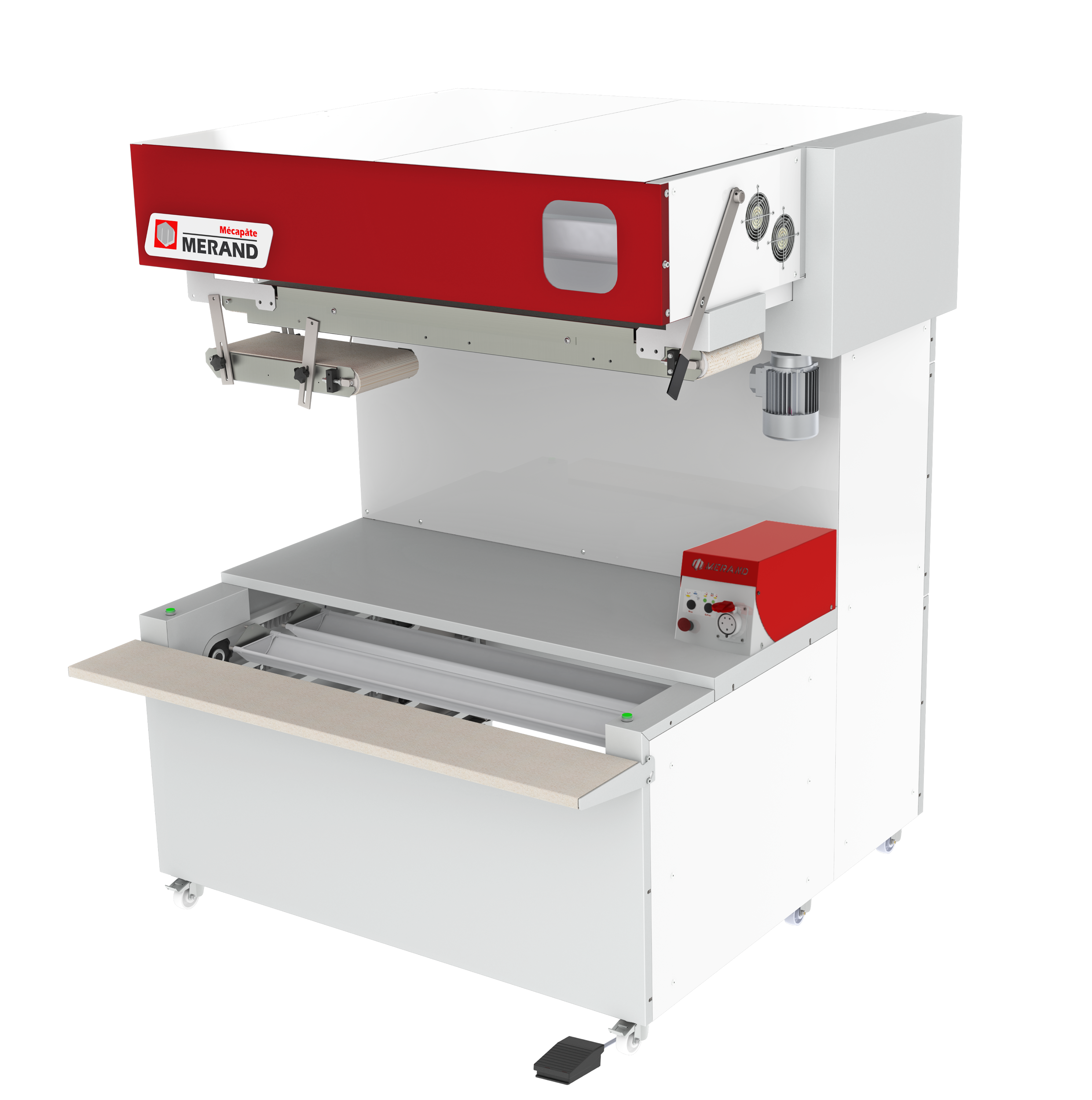
Everything you have just read—orienting the gluten, loading then relaxing the elastic spring, letting fermentation reactions do their work, stopping at the right moment—these are exactly the functions our proofing solutions ensure, whether by hand or in a fully automated line. Always following the same principle: never constrain what you are in the process of relaxing.
PRE-ELONGATE WITHOUT STRESS — THE MF2S® SYSTEM
Orient without adding tension
Our Stress-Free Shaping system ensures the first pre-elongation of the dough piece immediately after division, without pressing or constraining the network. It is the exact mechanical translation of the principle: you orient the gluten toward the baguette without overloading the elastic spring that proofing must then dissipate.
PRE-ROUND WHILE RESPECTING STRUCTURE
The right rounding, at the right time
For round shapes, our Eccentric rounders ensure pre-rounding before proofing—light rounding that shapes and strengthens without battering; the motion replicates the baker's gesture to preserve alveolar structure, even on highly hydrated doughs. And when the product does not call for a round, the bypass in our RheoPan RotaBall line lets dough pieces flow directly to proofing: you shape only what needs shaping.
THE RIGHT TIME, ADJUSTABLE AND REPRODUCIBLE
Because every dough has its window
The right proofing time is not the same from one product to the next: yeast or sourdough, T65 or T80, every dough has its kinetics. This is precisely why our proofing chambers make it adjustable and reproducible: duration, controlled humidity, to stop the relaxation/fermentation race at the right point, batch after batch.
SAVE TIME WITH AUTOMATION
Proofing is no longer a bottleneck
The right time relaxes the dough; the right surface preserves it. Both conditions for a dough piece that reaches final shaping without a scar.
STATIC OR DYNAMIC
THE REAL DEBATE ABOUT PROOFING
A matter of respecting the dough, not just throughput
Not all proofing chambers are equal, and the difference is not a matter of speed: it is a matter of fidelity to the very principle of proofing.
- Static proofing chamber: the dough piece does not move. Placed in a Nyltex® pouch, it stays there motionless from loading to discharge. During all this time, it does one thing only: relax in place. Tensions dissipate, memory fades, the network softens, without any manipulation recalling it to order. This is the exact mechanical translation of everything preceding: you let the two clocks run without reloading the spring.
- Dynamic proofing chamber: the dough piece changes pouches at each rotation. To advance through the system, the dough piece tips from one pouch to the next—it falls, rolls, repositions itself. Yet each of these transfers is an involuntary micro-shaping: exactly the gesture that reloads elastic tension. At each rotation, the dough piece gains a bit of strength at the precise moment proofing seeks to make it lose it. Result: you restart the memory you wanted to erase, and proofing is never fully "consumed." This is not a problem when you want doughs with sufficient strength (example sandwich breads), but problematic for most other breads. Dynamic has the advantages of compactness, storing many dough pieces in little floor space, and lower cost (notably through a less sophisticated loader), but it pays for this in relaxation quality. Another limitation: dynamically, you can only introduce pre-rounded dough pieces, never pre-elongated ones.
MERAND's Choice. Our historical expertise is the static proofing chamber: the only one that fully respects proofing as physics demands it. We also offer a dynamic solution, Dynaproof, when space constraints demand it, but we state it clearly: for proofing quality, nothing beats a dough piece left untouched.
Proofing means leaving the dough piece alone. A pouch that makes it roll at each rotation gives back the strength you sought to release. Not to mention that each transfer is a risk for the dough piece landing poorly in the next pouch. Static never reloads what time has just dissipated.
THREE LEVELS OF AUTOMATION: Three Proofing Chambers, Three Bakeries
The same proofing, from the artisanal oven to the automated line
The function is always the same: give the dough piece the rest it needs, on Nyltex® pouches, in a hygienic chamber. What changes is the degree of automation, thus labor, throughput, and footprint. Three solutions for three bakery realities.
- MANUAL — THE DOUGH RESTING RACK (PAGE / MINI PAGE)
The artisan's simplicity
The operator places dough pieces after division, then retrieves them manually to bring them to the shaper. This is the simplest, most compact, and most economical solution—ideal for the artisan who wants controlled proofing without cluttering the bakery. Robust, mobile, hygienic. - SEMI-AUTOMATIC — THE PAGE PROOFING CHAMBER
Discharge that frees the operator
Loading always manual, but automatic discharge to the shaper: the operator no longer retrieves dough pieces one by one. While one operator divides and loads, discharge feeds the shaper on its own. Static type (the dough piece remains in the same pouch from loading to discharge), it optimizes proofing and alveolar structure. - AUTOMATIC — MECAFORM (BMF)
Proofing that never stops
Automatic loading and discharge: proofing integrates into the continuous line flow, operator handling reduced to a minimum, high throughput. This is proofing for the high-volume producer, without compromising respect for the dough piece.
|
Solution |
Loading |
Discharge |
Ideal for |
|---|---|---|---|
|
Dough Resting Rack |
Manual |
Manual |
Artisan · compactness · budget |
|
PAGE Proofing Chamber |
Manual |
Automatic |
Productivity without full line |
|
Mecaform (BMF) |
Automatic |
Automatic |
Semi-industrial · throughput · line |
From the dough resting rack to Mecaform, the physics does not change—only the number of tasks you entrust to the machine. It's up to you to find the balance between hand and automation.
✦
"Our machines are designed by bakers, for bakers."
Come meet us!
We welcome you to our BakingLab® to test our machines. Bring your flour, bring your questions, we'll provide the rest.
Next episode:
Shaping: Create a Skin, Then Lock It
The gesture that programs the bread