
BULK FERMENTATION: MANAGED FERMENTATION
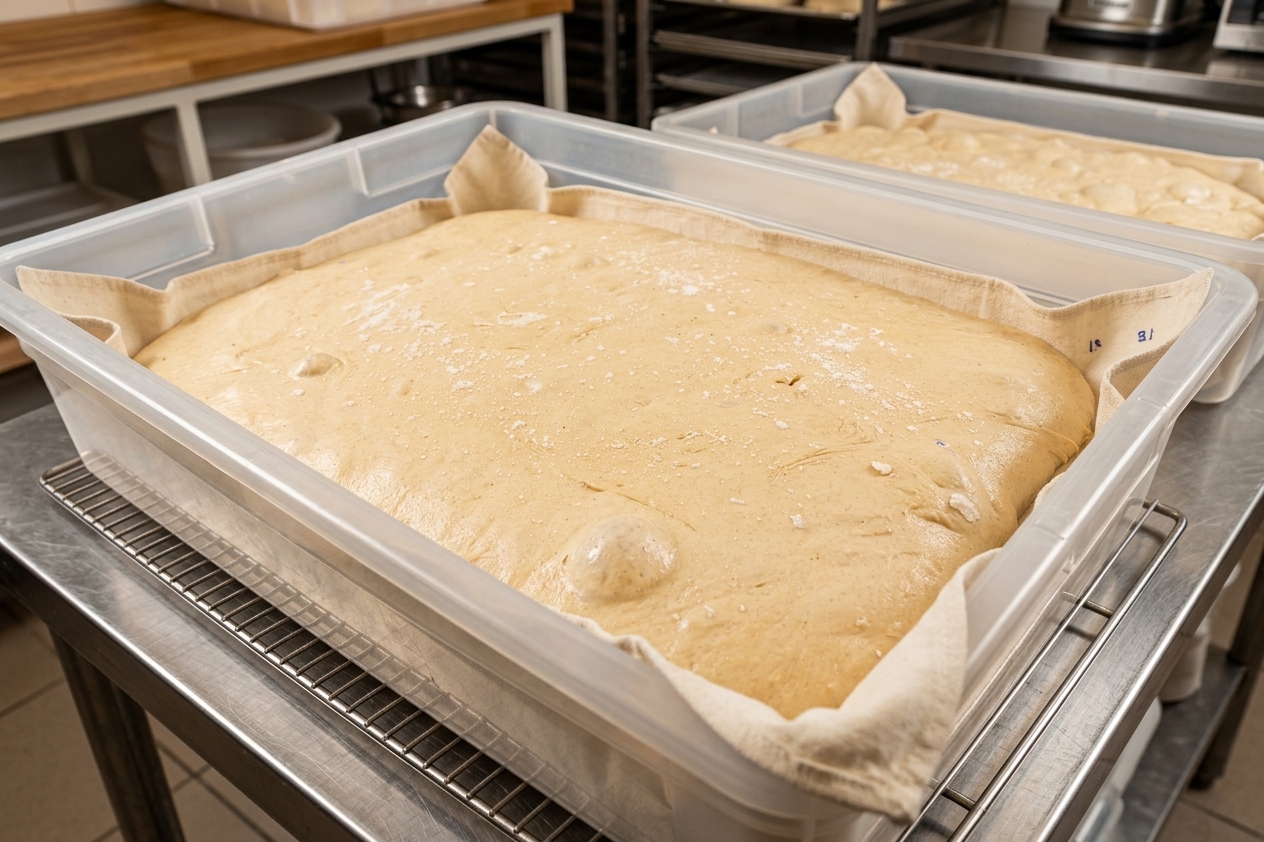
The first fermentation, where the essentials are built
Mixing is complete. The dough rests in bulk, undivided. From thirty minutes to eighteen hours depending on the method. During bulk fermentation, biology and chemistry transform the dough without the baker; but duration, temperature, and especially folds are decisions that shape the result. Bulk fermentation is not downtime you endure: it's a fermentation you manage.
Everything is decided here: flavor, structure, shelf life. And everything comes down to one balance—between what inflates the dough (fermentation) and what matures it (acidification and enzymes). Mastering bulk fermentation means regulating this balance.
PART 1 — WHAT TRANSFORMS
1. ALCOHOLIC FERMENTATION : The production of gas
Yeast (Saccharomyces cerevisiae) rapidly shifts to anaerobic metabolism and transforms fermentable sugars into gas:
GLUCOSE → 2 CO₂ + 2 ÉTHANOL + ATP
The CO₂ produced does not create new bubbles: it diffuses into the crumb nuclei already created during mixing and inflates them. This has a major consequence: final crumb structure is determined during mixing; bulk fermentation merely fills existing bubbles. Temperature controls everything: at 77 °F, exponential fermentation; at 39 °F, metabolism nearly suspended. Ethanol and byproducts already begin aroma development.
2. LACTIC & ACETIC FERMENTATION : The path with starter culture
With starter, lactic acid bacteria (LAB) work alongside yeast, via two pathways whose balance depends on temperature and hydration.
- Homofermentative pathway: glucose → lactic acid (round, sweet, creamy flavor).
- Heterofermentative pathway: glucose → lactic acid + acetic acid + CO₂ (sharp, vivid flavor, better shelf life).
At low temperature and low hydration, heterofermentative bacteria dominate: more acetic acid, crispier crust, extended shelf life. Conversely, warm, hydrated dough leans toward mild lactic flavor. The baker chooses the profile by adjusting temperature, hydration, and duration.
3. ACIDIFICATION : pH drop and its three effects
pH falls from ~6.2 at the start of bulk fermentation to 4.8–5.2 at the end (mature starter). This acidification is more than flavor: it structures the dough through three cascading effects.
- On gluten: ionic bonds strengthen, the network "tightens." Dough gains body, shaping becomes easier.
- On amylases: below pH 5.5, α-amylases slow, amylolysis self-regulates.
On unwanted microorganisms: below pH 5, pathogens and molds are inhibited: this is the natural preservation of sourdough bread. Acid here is as much an agent of structure and safety as of flavor.
4. AROMAS : What only time can build
During bulk fermentation, precursors form that will become aromas in the oven—and this is strictly a matter of time. Ongoing proteolysis releases amino acids (future fuel for the Maillard reaction); fermentation produces organic acids (crumb acidity), alcohols and esters (bouquet), aldehydes and ketones (hazelnut, butter, caramel notes).
The rule is unforgiving: short bulk at warmth → bland bread; long bulk at 39–43 °F (12–18 h) → complex aromas, thin and shattering crust. Bread flavor is not added; it's built over time.
PART 2 — WHAT THE BAKER MANAGES
5. DOUGH MATURITY : Fermentation versus maturation
This is the key to all bulk fermentation. Two processes advance in parallel but at different rates.
- Fermentation: the production of gas inflates the dough and gives it volume.
- Maturation: acidification and enzymatic work transform the dough deep within → flavor, extensibility, body, shelf life.
A dough "at point" is one where these two clocks arrive together: sufficiently inflated and sufficiently matured. The trap is they don't run at the same speed. At warmth, fermentation accelerates: the dough inflates quickly but hasn't time to mature → volume without flavor, fragile structure. At cold and long duration, maturation takes the lead: the dough matures fully while gas rises slowly → flavor and structure. Managing bulk fermentation means synchronizing these two clocks: through temperature, duration, and folds.
FERMENTATION (INFLATES) + MATURATION (TRANSFORMS) → MATURITY = BOTH AT POINT, TOGETHER
6. FOLDS : When the baker takes control
The fold—folding dough onto itself, in the bowl or on the bench, one or more times during bulk fermentation—is the gesture that proves bulk fermentation is managed. It acts via five simultaneous pathways.
- It restores strength. Folding reorients and retenses the network loosened by fermentation and proteolysis: chains realign, tenacity rises, P/L rebalances. A gentle mini-mix, without the mixer. You rebuild strength without starting from zero.
- It reboots fermentation. By folding, you expel some accumulated CO₂ (which eventually slows yeast) and re-expose yeast to fresh substrate and a bit of oxygen. Fermentation restarts like a shot in the arm, at the mass scale.
- It homogenizes. The fold equalizes temperature throughout the mass (a large block's core ferments faster than its edge: thermal inertia) and evens out crumb by fragmenting large gas pockets into finer nuclei → more regular crumb.
- It regulates crumb. Depending on whether you fold little or much, gently or firmly: firm, frequent folds → tight, regular crumb; gentle, rare folds → you preserve large alveoli of rustic breads. A true adjustment lever.
- And timing decides everything. A fold early or mid-bulk benefits (the dough has time to re-ferment and recover extensibility); too late, it retenses the dough without leaving time to relax → taut dough at shaping. On highly hydrated doughs, folds are even the method to build strength without mixing: short mixing, then series of spaced folds. This is the "Respectus Panis" method, or "REMESY," revived by Christian REMESY, research director in human nutrition at INRA.
7. TEMPERATURE, DURATION, COLD : The levers of control
The baker has three dials.
- Temperature regulates the speed of both clocks and their gap (cold slows fermentation more than maturation — it matures without over-inflating).
- Duration decides the depth of transformation.
- Cold in bulk or retarded bulk fermentation in a tub exploits this lag: place the bulk at cold (just above freezing), fermentation enters standby while aromatic maturation continues slowly, and you bench-proof a dough matured to perfection the next day. Same principle as cold final proofing, but applied to bulk fermentation: defer to mature.
8. DIAGNOSIS : Dough at the right point of bulk fermentation
- Volume: the dough has noticeably inflated without deflating, supple to the touch.
- Poke test: a gentle push retracts slowly and partially — neither sharp bounce (not mature enough) nor permanent indent (overproofed).
- Appearance: domed surface, lightly bubbled, that doesn't fall; on starter, a sharp tangy smell, not pungent.
- Body: the dough holds, doesn't stick excessively, allows handling: fermentation and maturation synchronized.
✦
«Bulk fermentation is not the moment you wait for the dough to be ready. It's the moment you make it ready—through the time you give it, the heat you leave it, and the folds by which you keep your hand in. »
PRINCIPLE OF BULK FERMENTATION · MANAGED FERMENTATION
|
What Happens |
Actors |
Effect on Bread |
|---|---|---|
|
Alcoholic fermentation |
Yeast |
CO₂ → crumb alveoli inflation |
|
Lactic/acetic fermentation |
Bacteria (starter) |
Acidity, flavor, shelf life |
|
Acidification (6.2 → 4.8–5.2) |
Organic acids |
Tightened gluten, food safety |
|
Proteolysis & aromas |
Enzymes, time |
Extensibility, aromatic precursors |
|
Dough maturity |
Fermentation + maturation |
Synchronized = dough at point |
|
Folds |
The baker |
Strength, reboot, regulated crumb |
|
Temperature / duration / cold |
The baker |
Speed and depth of transformation |
Technical Application : Managing and splitting bulk fermentation — MERAND Mécapâte
Bulk fermentation belongs to the baker and the bakery. But two moments of this step touch our machines: conducting bulk fermentation in the mixer, and splitting the mass so it can bulk-ferment under good conditions.
Bulk ferment and fold in the mixer: possible, but not optimal
Our mixers can run bulk fermentation in the bowl and even reproduce folds via programmed slow cycles. Convenient when space is tight. But let's be honest: dough bulk-ferments better at rest, in bulk, in a tub, than in the mixer. The mixer is a backup that structures; it doesn't replace the calm of bulk fermentation in a tub. We say it clearly, because it's true.
The DivBloc — a long-standing innovation
We offer the DivBloc, which divides the mass into several smaller pieces. For split-bulk, it's not ideal: it cuts finer, so earlier, than needed — when what's wanted is large blocks. We mention it for one reason: this approach the market is rediscovering today, MERAND Mécapâte has offered for over a decade. A house's experience isn't measured by the innovations it announces, but by those it's already mastered long ago.
Split for good bulk fermentation: the Rheobloc
An often-overlooked expert point: large bulk ferments poorly. Its core and periphery don't ferment at the same rate — that's thermal inertia. Our field advice is simple: don't exceed ~15 kg per block for uniform bulk fermentation. That's precisely the Rheobloc's function. Its star hopper divides the dough at mixer discharge into regular blocks of 7–8 kg that drop into a tub (one, two, or three blocks to choose), then automatic rotation to the next tub. The weight isn't precise, and that's intentional. We're after properly-sized blocks for bulk without inertia. The RheoPan will handle precise piece-weight division next.
Attention: don't confuse this. Here we divide the bulk into large blocks for good bulk fermentation. Piece-weight division comes after bulk fermentation—that's a different act, a different file.
✦
« Our machines are designed by bakers, for bakers. »
Visit us
We welcome you to our BakingLab® to test our machines. Bring your flour, bring your questions, we'll bring everything else.
Next episode
Dividing, An innocent step?
Cut without betraying: the paradox of volume and weight