
THE SCIENCE OF KNEADING IN PROFESSIONAL BAKING
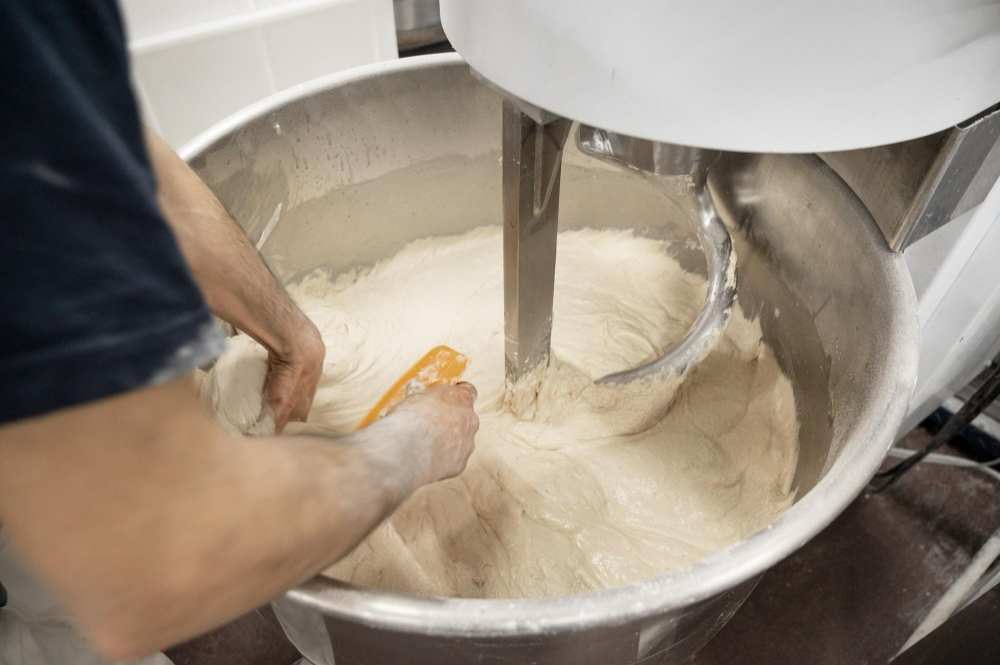
What actually happens in your mixer
Three phases. Dozens of molecular reactions. A working window of just a few minutes. Understanding these mechanisms means never getting a mixed dough wrong again. And it means understanding why every engineering choice in a professional mixer has a precise reason.
PHASE 01: REQUIRED
I — The Mixing Phase
The first contact between flour and water
Water enters the mixer. Flour follows. The paddle starts at first speed. What appears simple is actually one of the most critical moments in the entire baking process.
The mixing phase is when water makes contact with flour components in the mixing bowl. It must be done at low speed for a minimum of 6 minutes. Not by convention, but by physicochemical necessity.
1. Starch · Granule Swelling
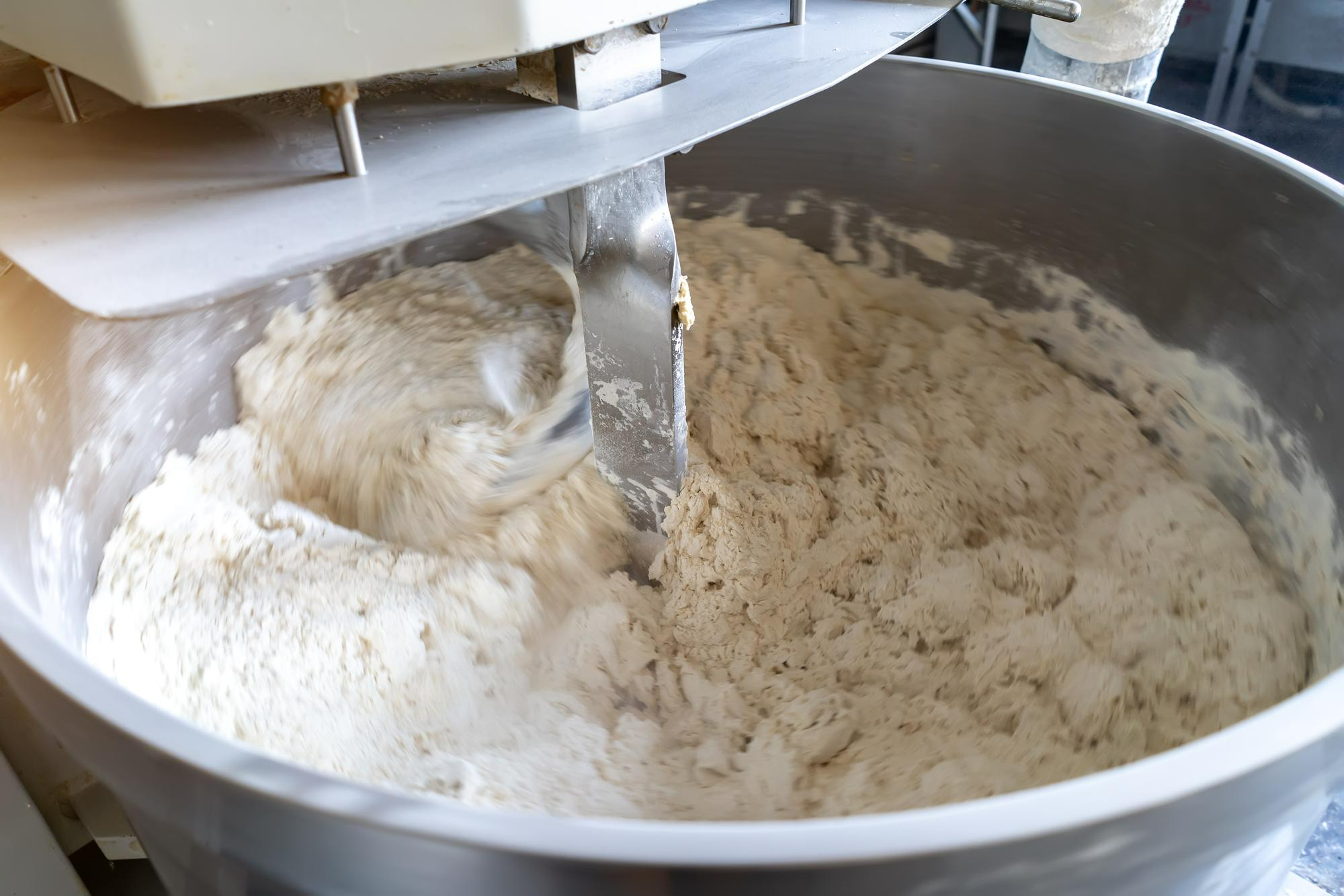
When water makes contact with starch granules, they absorb up to 30% of their weight in water and swell without dissolving. This process is slow — it takes time for water to penetrate the dense zones.
⚠️ Critical risk: A mixing speed that's too high would throw the flour before it's hydrated, creating irreversible dry zones in the center of the dough.
2. Proteins · Hydration of Gliadins and Glutenins
The two families of flour proteins, gliadins (extensibility, volume) and glutenins (elasticity, elongation) hydrate and begin to unfold. This hydration is slow and incomplete during rapid mixing alone.
The 6 minutes of low-speed mixing allows water to penetrate uniformly through all the protein mass, including the dense zones that resist water.
GLIADINS + GLUTENINS + H₂O → PRE-GLUTEN
3. Result · The dough is coarse, and that's normal
At the end of the mixing phase, the dough is heterogeneous, still friable in places. It has no strength, no structure. This is not a failure — it's the expected state.
The mixing phase doesn't build gluten — it creates the conditions for gluten to build itself. Everything that follows depends on the quality of this initial hydration.
Minimum duration: 6 minutes
PHASE 02 · OPTIONAL BUT POWERFUL
II — The Autolyse
Fermentation without yeast
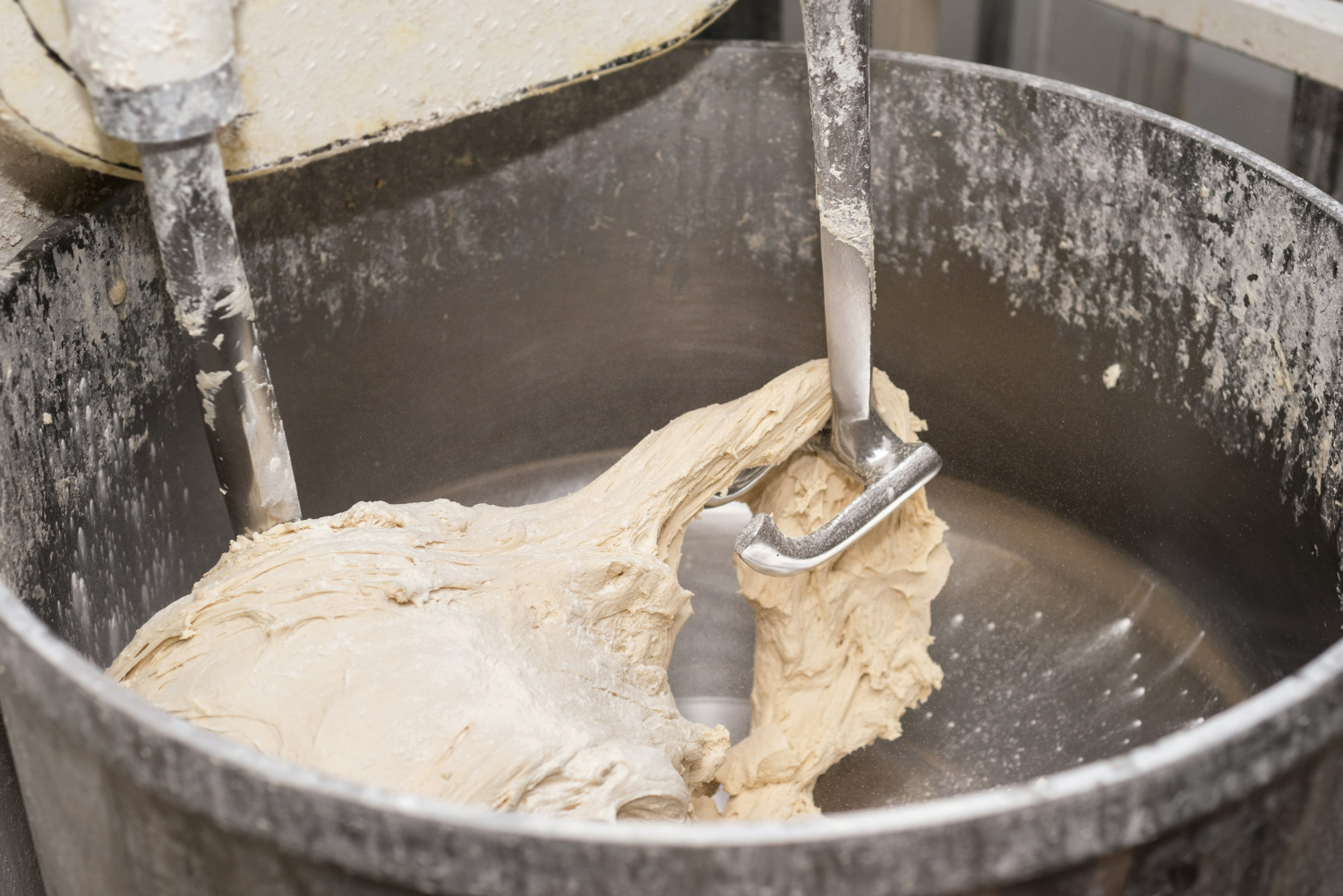
Dough rest, flour + water only, 20 to 60 minutes. Formalized by Professor Raymond Calvel in the 1970s. But it's not a rest — it's a silent molecular revolution.
Autolyse is not a mechanical pause. It's controlled enzymatic degradation, autonomous molecular restructuring, and chemical reduction of gluten — three simultaneous processes that transform the raw dough from mixing into a network ready to work.
1 - Enzymes · Activation of dormant proteases
Flour contains dormant cysteine-proteases and serine-proteases. As soon as water is present and temperature is favorable (68–77 °F), these enzymes activate and hydrolyze peptide bonds in long glutenin chains.
Result: The dough becomes mechanically more extensible and pliable — this is directed partial proteolysis.
2 - Self-organization · Autonomous gluten network formation
Without mechanical energy, partially hydrated protein chains align and form hydrogen bonds and disulfide linkages spontaneously. This self-organized network is more regular and homogeneous than one produced by mixing alone.
Why: Mixing introduces turbulence where autolyse lets molecules find their natural equilibrium.
3 - Chemical paradox · Reduction of disulfide bonds
In the absence of oxygen (compact, unaerated dough), oxidized disulfide bonds are partially reduced to thiols. This reducing phenomenon softens the gluten. It's the opposite of intensive mixing, which oxidizes and stiffens.
Paradoxical result: A dough that's both better structured and more extensible.
4 - Amylases · Beginning of amylolysis
Alpha and beta-amylases break down damaged starch from milling into dextrins, then maltose — fermentable sugars. This sugar will feed the yeast during mixing. Autolyse prepares the ground without triggering fermentation, since without yeast, there's no CO₂.
⚠️ High-enzyme flours: On flours above 80 Falling Number, spelt, or heritage varieties like Khorasan, autolyse that's too long produces excess simple sugars that make the dough sticky.
✦
« A 30-minute autolyse reduces the necessary mixing time by 25 to 35%, and produces a gluten network that no mixing alone can equal. »
RAYMOND CALVEL - 1970
|
Parameter |
Without Autolyse |
With 30-min Autolyse |
|---|---|---|
|
Extensibility |
Low to moderate |
+20 to 40% |
|
Tenacity (resistance) |
High |
Reduced · soft dough |
|
Mixing time |
100% |
−25 to 35% |
|
Alveolar development |
Standard |
Superior |
|
Aromatic precursors |
Standard |
Highly superior (releases amino acids) |
|
Friction heating |
Standard |
Reduced (shorter mixing) |
PHASE 03 - POWER PLANT
III — Final Dough Development
Incorporation, consolidation, dough maturity
Final dough development is the central phase in baking. The dough entering development after autolyse is not the same as dough that's just been mixed. Development doesn't start from zero — it aligns, binds, and consolidates what has self-organized during autolyse.
1 - INCORPORATION Salt · The ionic shock
Salt isn't just for flavor — it's a physicochemical necessity. NaCl dissociates into Na⁺ and Cl⁻ ions that bind to carboxylate groups (–COO⁻) on protein chains, neutralizing the negative charges that repelled each other. Result: Chains draw closer, new hydrogen bonds form, the network becomes denser, more taut, more elastic. Simultaneously, salt captures free water and inhibits proteases, stopping the autolyse proteolysis at exactly the right moment.
⚠️ Golden rule: Salt should never contact yeast directly — it's toxic to it.
2 - Incorporation · Yeast or Starter
- With commercial yeast: They aren't yet metabolically active; their activity (zymase, maltase) begins with temperature rise and substrate availability.
- With starter: You inoculate an already-active mixed population (yeast + lactic acid bacteria). The starter brings its own organic acids (pH 3.8–4.2), which immediately lower dough pH, modify protein ionic charge, and strengthen gluten before mixing even begins.
3 - Mechanical work · Gluten · Alignment and bonding
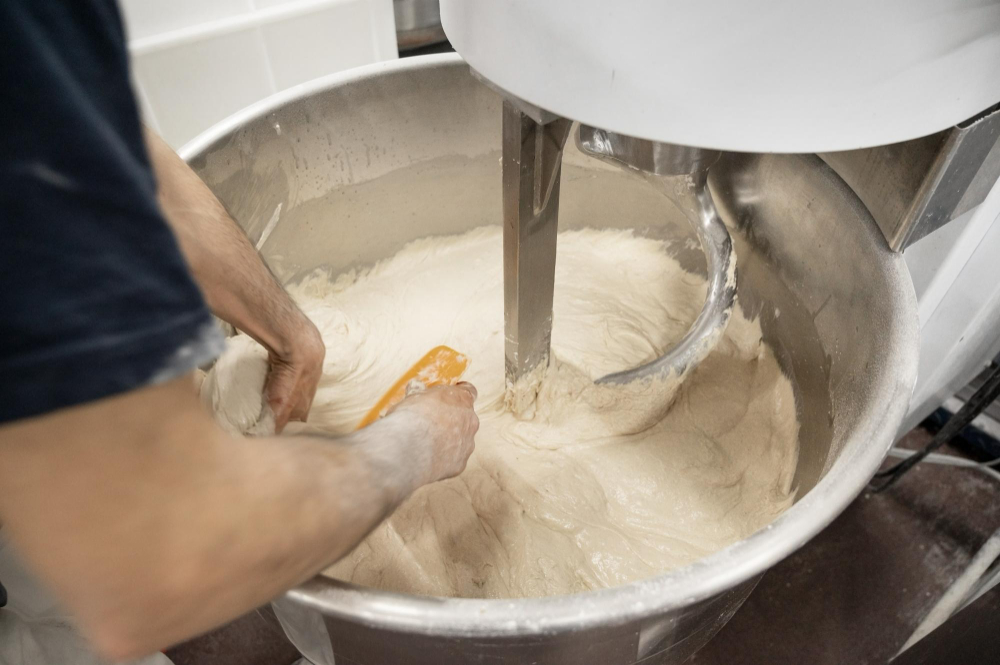
Each mixer revolution exerts shear, elongation, and compression forces on the protein network. Long glutenin chains, randomly organized after autolyse, progressively orient in the direction of effort.
Simultaneously, the physical proximity of thiol groups (–SH) from different chains, in the presence of oxygen, forms inter-chain disulfide bridges (–S–S–) that weld the network. It's cumulative — each minute of mixing adds more bonds.
–SH + –SH + O₂ → –S–S– · CUMULATIVE PROCESS
4. Delayed incorporation · Water additions (Optional but powerful)
Concept: Add water after the initial mix, in a slow stream, onto gluten that's already formed. Reserve 3 to 10% of total water for this step. You only water-in what already has structure.
Why delay: A firmer dough transmits mechanical energy better. You build the network under optimal friction conditions, then loosen it. At equal final hydration, "firm then watered" produces better-oriented gluten.
Redistribution — three reservoirs: Added water is captured by already-hydrated gluten, damaged starch, and especially arabinoxylans (pentosans) — the flour's water sponges. Hence why flour rich in pentosans (80 Falling Number, heritage wheats) accepts more delayed water.
Kinetics — free water to bound water: At the moment of addition, water is free — the dough "floats." Slow mixing that follows allows it to bind to the network and the dough "grips." Adding too quickly exceeds the binding rate, as irreversible as overmixing.
5 - Oxygenation · Critical balance · The paradox of incorporated air
Air bubbles incorporated during mixing are the nuclei for crumb structure — CO₂ from fermentation doesn't create new bubbles, it inflates the ones created during mixing. But the oxygen in these bubbles has a double effect:
- Positive: Oxidizes disulfide bonds (strengthens gluten), activates lipoxygenases.
- Negative: Oxidizes carotenoids, pigments responsible for cream color and aromatic precursors. A heavily mixed bread: white, airy crumb, no flavor. A lightly mixed bread: cream crumb, irregular, aromatic.
6 - Thermal dynamics · Hidden variable · Friction coefficient
Each mixer revolution converts some mechanical energy to heat. This warming is specific to each machine:
WATER TEMP = (3 × DESIRED DOUGH TEMP) − FLOUR TEMP − AMBIENT TEMP − FC
7 - Diagnosis · Dough maturity · Reading the optimum
Mixing stops not at a fixed time, but when the dough reaches its optimum. Three simultaneous indicators:
- Gluten window test: Stretch a piece of dough between your fingers. A translucent film with no tears = gluten at maturity. Immediate tearing = underdeveloped. Too resistant = risk of overmixing.
- Temperature probe: The most objective and actionable parameter.
- Visual appearance: Smooth, silky dough, peels cleanly from the bowl, slightly recovers its shape after deformation.
⚠️ Overmixing — irreversible: The network breaks, the dough becomes shiny and sticky. There is no recovery.
|
Mechanical action |
Physicochemical effect |
Result on dough |
|---|---|---|
|
Repeated shear |
Chain alignment |
Oriented network, stronger |
|
Protein proximity |
Formation of –S–S– bonds |
Elasticity, cohesion |
|
Air incorporation |
Oxidation + crumb nuclei |
Future crumb structure |
|
Water additions (delayed) |
Plasticization · pentosan hydration |
Extensibility ↑ · P/L ↓ · open crumb |
|
Friction |
Heating 1–4 °F |
Yeast activation |
|
Salt dispersion |
Protease inhibition + ionic reinforcement |
End of proteolysis |
|
Overmixing |
Chain rupture |
Sticky dough — irreversible |
TECHNICAL APPLICATION
Why MERAND MIXER
Un pétrin n'est pas une machine qui mélange. C'est un instrument de précision qui intervient dans des réactions moléculaires irréversibles. Chaque compromis d'ingénierie a un impact direct sur le gluten, les arômes et le travail du boulanger.
Tout ce que vous venez de lire, frasage à vitesse 1, paradoxe de l'autolyse, coefficient de friction, sur-pétrissage irréversible, ce sont exactement les contraintes auxquelles nos ingénieurs ont répondu. Pas de marketing. De la mécanique appliquée à la biochimie.
Speed · Stable speeds
Calibrated speeds at low or high regime, constant, without jerks or torque variation. The paddle doesn't accelerate when hitting dense flour zones — it maintains the same effort, guaranteeing uniform starch and protein hydration from first contact and consistent mixing.
Independent control of paddle speed and bowl speed to manage dough heating optimally.
Programmable autolyse
Automatic rest phase programming between initial mix and final development. The bowl remains stationary, dough temperature monitored continuously.
Probe · Real-time temperature tracking
Our mixers are equipped with a probe for real-time dough temperature monitoring and control of friction coefficient and water additions.
Integrated weighing
Good mixing begins with accurate weights. The integrated weighing system allows each ingredient to be added at the right moment and every amount to be validated, including water reserved for later additions.
✦
Visit us
We welcome you to our BakingLab® to test our machines in real conditions. Bring your flour, bring your questions, we'll bring everything else.
Next Episode: Racking
The first fermentation—where the foundation is laid