
Which dough mixer for your bakery? Spiral, oblique axis or diving arms
Your choice of mixer has a direct impact on crumb texture, bread colour, how well high-hydration doughs hold up and the pace of your bakehouse. There are three main technologies, and none is better than the others in absolute terms: each has its strengths depending on the bread you want to make and the way you work. This guide compares them point by point.
Spiral, oblique axis, diving arms: the short answer
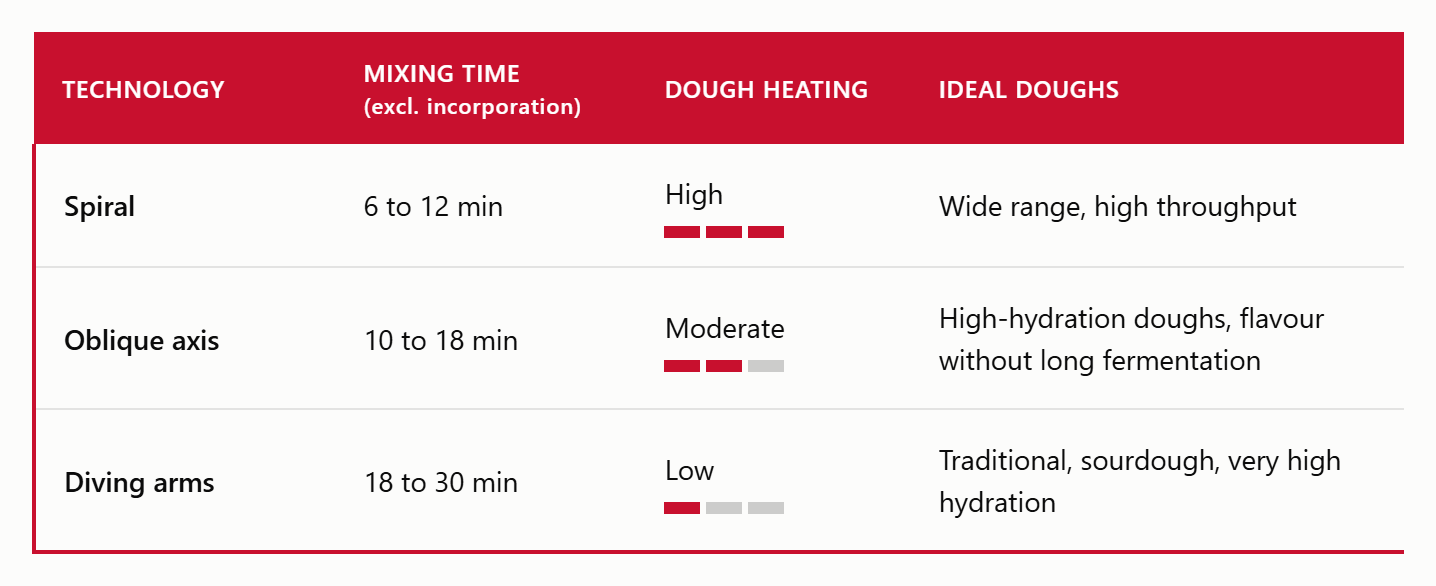
The spiral mixer works the dough quickly using a fixed spiral tool and a rotating bowl. It develops the gluten network fast, warms the dough slightly more and suits high-throughput production as well as a wide range of recipes. Allow 6 to 12 minutes of mixing (excluding incorporation). It is now the best-selling mixer, thanks to its versatility and speed.
The oblique axis mixer kneads with an inclined, gentler movement that aerates the dough without forcing it. It heats the dough less than a spiral and works faster than diving arms (10 to 18 minutes, excluding incorporation), and it excels with high-hydration doughs: an excellent compromise between flavour and throughput.
The diving arm mixer reproduces the baker’s hand movement: two arms plunge into, lift and aerate the dough. Mixing takes longer (18 to 30 minutes, excluding incorporation), with much less oxidation and heating. It is the preferred choice for Tradition bread, very high-hydration doughs and long fermentation.
In a nutshell: the spiral favours output and consistency, diving arms favour flavour and the suppleness of high-hydration doughs, and the oblique axis bridges the gap between the two.
The spiral mixer: throughput, consistency, versatility
The spiral mixer has become the bakehouse standard for good reason. It mixes in 6 to 12 minutes (excluding incorporation), where other technologies take twice as long or more. It handles batch after batch without flagging. Above all, it delivers the same result on Monday morning and Saturday evening, whichever team is in charge.
That consistency has direct commercial value: a customer who finds exactly the same bread on every visit is a customer who comes back.
Add a compact footprint, easy cleaning and immediate ease of use, and it is clear why the spiral now equips most bakeries. Its one point to watch: in summer, fast mixing warms the dough, so the temperature of the mixing water must be closely monitored.
Our spiral solutions. MERAND offers the spiral technology in three mixers, to suit the way you work:
- SpiMouv, with removable bowl, is the all-rounder of the range, from craft bakeries to semi-industrial production. Its two-speed spiral ensures even, well-oxygenated mixing, and its removable bowl lets you start the next batch while the previous one goes into bulk fermentation. From 154 to 413 litres, in two versions: SpiMouv ST for soft and medium doughs (hydration > 55%), and SpiMouv DT, the specialist for stiff doughs (laminated dough, croissant, stiff doughs ≤ 45%).
- SpiFix, with fixed bowl, is built for performance: two powerful motors and an exclusive spiral allow it to handle both very high-hydration doughs (+75%) and the stiffest doughs (−50%). Its TouchScreen display stores up to 25 recipes, and the AutoWeight system ensures precise weighing and dosing of ingredients.
- SpiSwing, self-tipping, combines a fixed-bowl mixer with a hydraulic lifter: it transfers the dough automatically to the dough table or the divider, with no manual handling. Two discharge heights (1400 or 1900 mm) and capacities from 75 to 150 kg of flour make it the ideal partner for bakehouses scaling up their output.
The oblique-axis mixer: flavour without longer mixing cycles
The oblique axis is the compromise many bakers are looking for without knowing it. Its inclined arm kneads with a movement that gently aerates the dough, closer to hand kneading than the spiral, but without the time penalty. The dough heats and oxidises very little: the flour’s pigments are preserved, the crumb stays creamy and aromas develop. It also handles high hydration very well, while remaining faster than diving arms.
It is the ideal technology if you want flavour and a beautiful crumb without moving to long fermentation or doubling your mixing times. Allow 10 to 18 minutes (excluding incorporation), an intermediate time between the spiral and diving arms.
Our oblique axis solutions. The Paxo, with fixed bowl, handles all types of dough, including the most hydrated. The Paxo Lift uses the same technology with a removable bowl and hydraulic lift, designed for intensive production environments and back-to-back batches.
The diving arm mixer: respect for the dough
Diving arms don’t shear the dough, they lift it. That movement changes everything.
The dough heats up very little, which makes work easier in hot weather and reduces the need for ice. It oxidises very little, preserving the flour’s natural pigments: the crumb stays creamy, aromas develop and the bread has character. Above all, this technology handles high hydration: Tradition bread at 72%, sourdough, ciabatta. Where other technologies struggle, diving arms build structure.
The trade-off is a longer mixing time, from 18 to 30 minutes depending on the recipe (excluding incorporation). This time fits naturally into a long-fermentation approach, but it has to be built into your organisation.
→ Our solution. The ARM diving arm mixer is designed for intensive use: pressure-cast iron frame, oil-bath mechanical drives, sealed ball bearings. It is not a low-cost assembly dressed up in sheet metal, but a design that withstands daily demands without drifting out of adjustment, while preserving the dough.
Which mixer for your bakery?
-
You produce a wide range in steady volumes. Everyday bread, viennoiserie, speciality breads, sometimes snacking. You need a machine that takes on everything without complaint, and a bakehouse that never stops.
→ SpiMouv. Two speeds to adjust intensity recipe by recipe, a removable bowl to keep batches flowing. And for laminated and stiff doughs, the DT version. -
Your recipes range from one extreme to the other. Very high-hydration doughs on one side, stiff doughs on the other. Most mixers can do one or the other, rarely both.
→ SpiFix. It covers hydration above 75% as well as below 50%, with touchscreen and built-in weighing. -
You want flavour without longer cycles. A beautiful creamy crumb, aromas, high-hydration doughs, but without moving to long fermentation.
→ Paxo (or Paxo Lift). The oblique axis preserves the dough while keeping a reasonable working pace. -
Tradition bread and sourdough are your signature. You sell flavour, a creamy crumb and an open crumb structure. Your hydrations run high and your fermentations are long.
→ ARM mixer. Its gentle mixing preserves exactly what you showcase in your window, with mechanics built for intensive use.
The mixer is only the start of the line
There is no best mixer, only the mixer that fits your project: the spiral for throughput and versatility, the oblique axis for flavour without longer cycles, diving arms if characterful bread is your signature.
Then comes the rest: removable or fixed bowl, lifter, divider, moulding line. It is the consistency of the whole set-up that makes good bread, not a single machine.
An equipment or mechanisation project? Let’s talk. The MERAND MECAPATE teams support you, from sizing your mixer to designing the complete line.