
Baking & Cooling: Transform and set
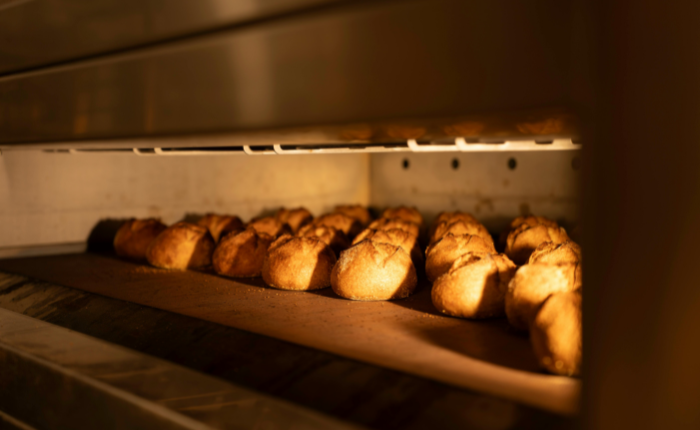
The moment dough ceases to be dough
All is decided, or nearly so. The dough piece has been mixed, divided, relaxed, shaped, proofed, scored. It enters the oven fragile, swollen, alive. It will emerge rigid, colored, resonant: bread. Baking adds no new skill; it merely reveals and sets everything that precedes it. The oven is an unforgiving judge: It fixes nothing, it makes visible. And cooling, which we often overlook, is bread's final act: only as it cools does it truly become itself.
PART 1 — BAKING
1 - THE OVEN SPRING: The final push
In the first few minutes, bread undergoes its final and most violent expansion: the oven spring. Three physical phenomena combine violently under the effect of heat.
First, gases already present expand: the CO₂ from fermentation and trapped air increase in volume with temperature. Next, and this is the main driver, often underestimated, water and ethanol vaporize: in changing from liquid to gaseous state, they occupy considerable volume (vaporized water occupies more than 1,000 times its liquid volume), inflating the air cells from within. Finally, one last fermentation surge: just before dying, the yeasts, stimulated by rising heat, produce a final burst of CO₂.
This surge lasts only as long as the crust remains supple and the crumb is not yet set. This is exactly the window that the score opens: under pressure, the cut widens, the lip rises as an ear, the bread blooms in the desired direction. Oven spring is the moment when all the gas patiently produced and retained converts into volume, provided the crust holds it long enough to inflate, and yields just where it should.
HEAT → GAS EXPANSION + VAPORIZATION (WATER, ETHANOL) + YEAST SURGE → OVEN SPRING
2 - STEAM: Why we load with steam
Injecting steam at the moment of loading is not a detail: it is what makes oven spring possible. The steam condenses on the cold surface of the dough piece and keeps the skin moist, therefore supple and extensible, long enough for expansion to occur. Without it, the surface dries and sets too soon: the crust forms before oven spring ends, constrains the volume, and the score cannot open (it tears instead of blooming).
Steam has a second, chemical effect: surface water gelatinizes the starch of the skin, which in drying afterwards will give a thin, shiny, crispy crust. Too much steam drowns development and softens it; too little constrains and dulls it. Steam is the indispensable partner to oven spring: it buys time for the skin.
3 - THE DEATH OF YEASTS: Biology shuts down
As the internal temperature rises, life stops. Around 50-60 °C, the yeasts die: CO₂ production ceases permanently. Enzymes remain active a little longer (a final work of starch degradation that feeds coloration), then denature in turn. Fermentation is over. From here on, nothing is alive: the dough is no longer a working organism, it is matter that heat transforms. Physics definitively takes over from biology.
4 - STARCH GELATINIZATION: The crumb takes shape
This is the heart of the transformation. Between 60 and 85 °C, starch granules, hitherto inert, absorb available water, swell and burst, releasing their starch which forms a gel. This phenomenon, gelatinization, transforms soft dough into manageable crumb. The gelled starch sets the alveolar structure: the walls between bubbles, hitherto extensible, become solid. Without gelatinization, no crumb, just warm dough that would collapse.
This is also why water is so precious to the end: gelatinization consumes the free water in the dough. A well-hydrated dough gelatinizes fully and gives a supple crumb; a dough that is too dry gelatinizes poorly and gives a dense, crumbly crumb.
5 - GLUTEN COAGULATION: The framework sets
In parallel, between 70 and 80 °C, gluten proteins denature and coagulate (like egg white turning from translucent and liquid to white and firm). The elastic and extensible network we built, oriented and tensioned since mixing becomes permanently rigid: it becomes the framework that holds the bread upright.
The two mechanisms work in relay: coagulated gluten forms the skeleton, gelled starch fills and sets the walls. Together, around 90 °C at the core, the crumb is "set," baked through. As long as the crumb contains water, its temperature cannot exceed 100 °C: evaporation caps it. The core thus rises toward 95-98 °C without going beyond. The structure is now irreversible: we cannot return to dough. This is the exact moment where dough ceases to be dough.
60-85 °C: STARCH GELATINIZES · 70-80 °C: GLUTEN COAGULATES · ~90 °C AT CORE: CRUMB SET (CEILING ~100 °C)
6 - THE CRUST: Maillard and caramelization
While the core sets around 100 °C, the surface experiences an entirely different regime. Deprived of water (steam stops, moisture evaporates), the crust far exceeds 100 °C and rises toward 140-180 °C. Two families of reactions are triggered.
The Maillard reaction (from ~140 °C): reducing sugars react with amino acids to form hundreds of brown and aromatic compounds: this is what gives the crust its golden to brown color, as well as its smell and taste. Caramelization (from ~160 °C): sugars degrade under heat, adding color and caramelized notes. The crust forms because the surface dehydrates and rigidifies, while these reactions color and flavor it.
This is where the dividends of fermentation show: dough that retained enough residual sugars (not over-fermented) colors well. A dough exhausted by fermentation gives a pale crust, a sign fermentation went too far. The color of the crust tells the story of fermentation.
7 - BREAD IN GRADIENT: Two worlds in a single bread
A bread that bakes is never at a single temperature: it lives in a gradient. The crust is dry and burning (>150 °C, dehydrated, in full Maillard reaction); the core caps below 100 °C, moist, in full gelatinization. Between the two, a front moves from the outside toward the inside as baking progresses: the "set" zone advances toward the center.
Water, meanwhile, migrates in both directions: some evaporates through the surface (bread weight loss, ~10-15%), some is pushed toward the interior by the heat front. It is this gradient of water and temperature that explains why bread must bake long enough: the front must reach the center (the ~90 °C) so that the crumb is set everywhere. A bread removed too early has a pasty, ungelled core that will collapse.
PART 2 — COOLING
8 - COOLING: Bread finishes being born as it cools
At the oven's exit, the bread is not finished. We think it is finished because it is colored and sounds hollow, but its internal structure is still hot, moist and unstable. Cooling, the resting, is bread's final physical act, and it lasts far longer than baking.
Three things happen. First, water continues to migrate and evaporate: the core, still hot and laden with moisture, pushes its vapor toward the crust, which lets it escape. The bread loses more weight, and this water movement balances humidity between a dry crust and a soft crumb. Next, the crumb finishes setting: gelatinization and coagulation stabilize as it cools, the starch gel firms up, the structure becomes workable. This is why cutting bread too hot gives a sticky, gummy crumb: not because it's underbaked, but because the structure hasn't finished stabilizing. You must let the bread cool.
And then the bread sings. This crackling of the crust at the exit is a real physical phenomenon as well as real poetry for the baker's ears: the hot, dry crust contracts as it cools while the crumb, still moist and expanded, moves beneath it; differential tensions finely crack the crust: it crackles, it sings. A singing bread is bread whose crust is dry, thin and well-formed: it is the sonic signature of successful baking.
Finally, staling begins, softly. As cooling starts, gelled starch begins its retrogradation: its molecules, especially amylopectin, slowly reorganize into a more ordered, more crystalline and more rigid structure, which gradually expels the water it absorbed during baking. This is the beginning of crumb hardening. Nothing stops it, but its speed is determined during fermentation.
Everything depends on the state of water in the bread. Not all water is equivalent: there is bound water (immobilized by starch, gluten and especially pentosans) and free water, mobile and available — this is what water activity (aw) measures. Now retrogradation needs mobile water to advance. A bread whose water is well retained and redistributed, but with little free water, stales more slowly: this is the entire interest of good hydration, a well-built network, and flours rich in pentosans, which trap water and keep it in the crumb instead of letting it migrate and evaporate.
Acidity adds its effect, by another route. A sourdough paste, more acidic (low pH), slows retrogradation: acidity modifies enzyme action on starch and hinders its recrystallization, while long fermentation solubilizes compounds that retain water better. This is one of the reasons, beyond taste, why sourdough bread keeps longer than yeast bread.
Thus bread's shelf life is not a fate passively accepted at the end: it is decided throughout the baker's work: through hydration, through flour, through the conduct of fermentation. A well-made bread, well-hydrated, with long fermentation, stales more slowly. The bread's end is written, too, in its beginning.
✦
"The oven creates nothing: it reveals and sets. Everything bread will become in the fire, it owes to what was done to it before. Heat is merely the final judge in a long chain."
BAKING PRINCIPLE · HEAT: TRANSFORM AND SET
|
Mechanism |
Threshold / Physics |
Consequence for Bread |
|---|---|---|
|
Oven spring |
Gas expansion + water/ethanol vaporization |
Final push, score opening |
|
Steam |
Surface kept moist |
Supple skin, fine and shiny crust |
|
Death of yeasts |
~50-60 °C |
End of fermentation |
|
Starch gelatinization |
60-85 °C |
The crumb takes shape |
|
Gluten coagulation |
70-80 °C |
Rigid framework, frozen structure |
|
Crumb set at core |
~90 °C (ceiling ~100 °C) |
Bread baked through |
|
Crust (Maillard / caramelization) |
140-180 °C at surface |
Color, aroma, crispness |
|
Cooling |
Cooling, water migration |
Stabilized crumb, singing crust |
|
Retrogradation |
As cooling begins |
Beginning of staling |
✦
"Our machines are designed by bakers, for bakers."
Come meet us!
We welcome you to our BakingLab® to test our machines. Bring your flour, bring your questions, we'll bring the rest.
Conclusion:
Bread is a chain