
Proofing and Scoring: The Final Fermentation, The Final Gesture
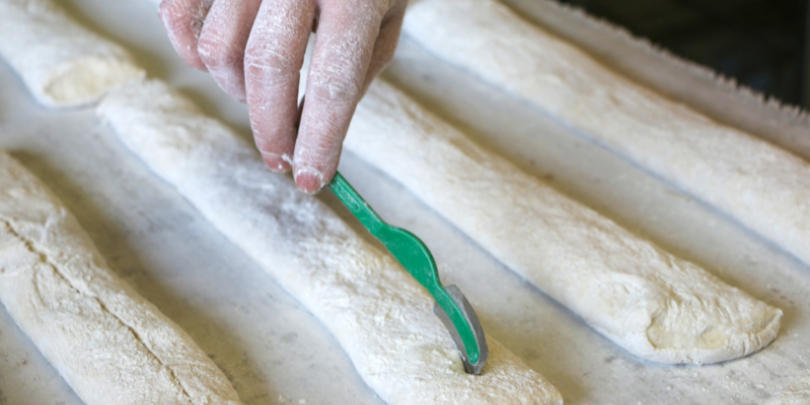
The Final Rise, and the Final Gesture Before the Oven
The bread is shaped. Its skin is taut, its crumb aerated, its seam sealed. Everything is in place, except for volume. One essential element is still missing: the gas that will inflate it, and the control of that gas until it reaches the oven threshold. The scoring determines where it will expand. Two gestures that barely touch the dough, and yet they control the final volume and the appearance of the bread.
PART 1: FINAL PROOFING
1 - WHAT HAPPENS: Fermentation at Last Set Free
Final proofing (or proofing, or second fermentation) is the last fermentation before baking. This time, unlike bulk fermentation, the dough is shaped and stationary: we no longer work it, we let it ferment. The yeasts, which have fermentable sugars in reserve (released by amylases since mixing), continuously produce CO₂. But the key phenomenon of proofing is not gas production: it is gas retention.
Everything we built before serves here. The gas produced only inflates the bread if the taut skin from shaping retains it, and if the gluten network is strong and extensible enough to stretch without tearing. Proofing is therefore the moment when the dough reaps the rewards of all previous steps: a well-constructed network (mixing), minimally damaged (dividing), properly relaxed (resting) and well-tensioned (shaping) expands evenly and holds firm. A network compromised at any earlier step now leaks, collapses, or tears.
YEAST → CO₂ (PRODUCTION) · SKIN + NETWORK → RETENTION · VOLUME = PRODUCTION × RETENTION
2 - THE MECHANICS OF EXPANSION: Internal Pressure Against Skin Resistance
Physically, proofing is a balance between rising internal pressure and the resistance opposing it. CO₂ accumulates in existing alveoli (it does not create new ones: it inflates those formed during mixing and calibrated during shaping). The internal pressure of each alveolus still obeys Laplace's law (ΔP = 2γ/r): smaller bubbles are under higher pressure and tend to diffuse their gas into larger ones, hence the progressive coalescence and the enlargement of alveoli throughout the proofing.
Against this pressure, the network opposes its extensibility: it stretches like a balloon. As long as it responds, the bread rises evenly. If it is too tenacious (under-proofed dough, excess strength), it resists, proofing is checked, volume remains small. If it is too relaxed (over-fermented dough, degraded gluten), it no longer retains: the cell walls tear, bubbles merge, gas escapes, the bread collapses.
3 - TOLERANCE: The True Measure of Proofing Quality
The decisive parameter is not the speed of rise, it is tolerance: the width of the window during which the bread is "ready for the oven." A tolerant dough stays at its peak for a long time; a dough with low tolerance shifts from the perfect point to collapse in just minutes.
Tolerance is built upstream: a strong, well-structured gluten network, fermentation not pushed too far, just the right amount of tension during shaping. This is why it is the ultimate judge of the entire baking process. It reveals, at the end, whether the entire chain has been properly managed.
It shows itself in three states:
- Under-proofed (not enough rise): dense, heavy bread that tears violently in the oven, explosive and chaotic scoring.
- At its peak: full volume, taut but supple skin; the bread accepts the blade cleanly and develops in the oven.
- Over-proofed (too much rise): exhausted network, the bread collapses at the blade or in the oven, little oven spring, soft scoring, irregular crumb.
UNDER-PROOFED → TEARS, DENSE · AT PEAK → DEVELOPS · OVER-PROOFED → COLLAPSES, FLAT
4 - TEMPERATURE & HUMIDITY: The Two Control Levers
Proofing is controlled by two levers. Temperature commands the speed: the warmer it is (up to ~28°C in the proofer), the more active the yeasts, the faster the rise. But if too warm, it produces less flavor and less tolerance. Humidity protects the skin: a humid atmosphere prevents the surface from crusting during proofing—between 78 and 80% humidity is ideal. A skin that crusts during proofing means poor scoring and limited development. Premature crust blocks expansion. This is the whole value of a controlled proofer: speed regulated, skin preserved.
5 - COLD-CONTROLLED PROOFING: Delaying to Master
Cold has transformed the trade, and it is a proofing controlled by temperature, not a separate step. The principle is simple: cold slows yeasts far more than enzymes and bacteria. We exploit this gap.
In delayed bulk fermentation or controlled proofing, shaped dough pieces are placed in cold (~3-6°C): CO₂ production is paused, but enzymes and aromatic fermentation continue slowly. We gain flexibility in scheduling (load the oven when we want) and flavor development. When the moment comes, we reheat: the yeasts restart, the rise finishes.
In blast freezing (negative cold), we stop everything: the raw, shaped dough piece is frozen to be baked later. But negative cold has a physical cost, and we must understand where it comes from. Water is one of the rare substances that expands when it freezes: as it shifts from liquid to solid state, it increases in volume by approximately 9%. In the dough, water trapped within the network then forms ice crystals that grow and tear the gluten cell walls from the inside, and pierce the membranes of yeast cells.
The degree of damage depends on a single parameter: freezing speed. Slow freezing allows large crystals to form, which lacerate the network and kill the yeasts; blast freezing locks water into microcrystals dispersed throughout, too small to cause damage. This is the entire meaning of the word blast freezing. It is not "to freeze," it is to freeze fast enough to preserve structure. Upon thawing, the water melts and redistributes: if the network has been damaged, it no longer retains it, the dough becomes sticky and slack.
Hence the need for specific doughs: more strength (a robust network, capable of withstanding the expansion of freezing without breaking) and more yeast (to compensate for cold-induced mortality). Once again, everything relies on the quality of the network built upstream: a fragile dough, poorly structured at mixing or over-fermented, does not survive negative cold.
Cold does not suspend physics, it sorts it: it puts yeasts to sleep and keeps enzymes awake. The entire art of cold lies in playing on this gap.
PART 2: SCORING
6 - WHY SCORE: Provide an Outlet for the Gas
At the end of proofing, the bread is under pressure: filled with CO₂, its skin stretched to the limit. In the oven, heat will suddenly expand this gas and vaporize water, internal pressure will spike. It must escape somewhere. If we don't decide where, it decides for us: the bread tears at the weakest point, often on the side or under the base, in an ugly and uncontrolled way.
Scoring is deliberately creating a zone of lesser resistance: a slit where the skin, locally cut, will give way first. We channel the tear. The entire function of the score lies there: it is not decoration, it is a directed valve.
 7 - WHAT HAPPENS AT THE BLADE: Physics of the Score
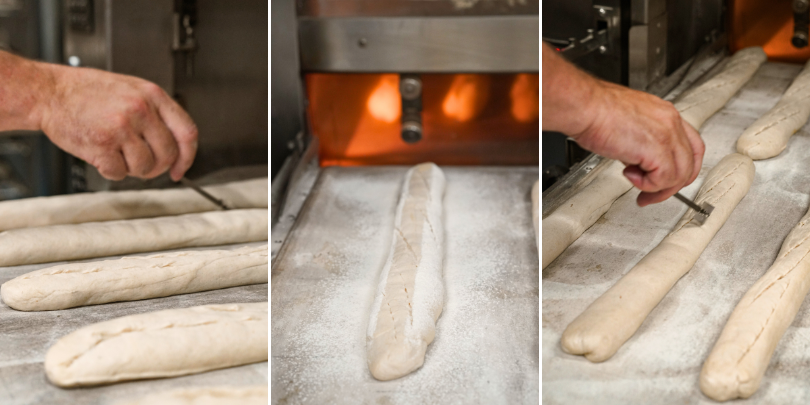
The slit cuts the taut skin without reaching the crumb. In the oven, under the push of gas, the lips of the slit spread apart: the still-soft dough tears along this weakened line and blooms. This is the score: this opening that lifts into a ridge. Three mechanisms work together here: the slit releases pressure in a directed way (the bread develops in that direction rather than exploding randomly); the diagonal and shallow cut creates a lip (the blade passes almost flat under the surface, lifting a thin flap of skin that rises in the oven as a score); and the slit controls the expansion (a well-scored bread opens evenly and rises; poorly scored, it remains checked or bursts on the sides).
8 - THE RIGHT GESTURE: Angle, Depth, Sharpness
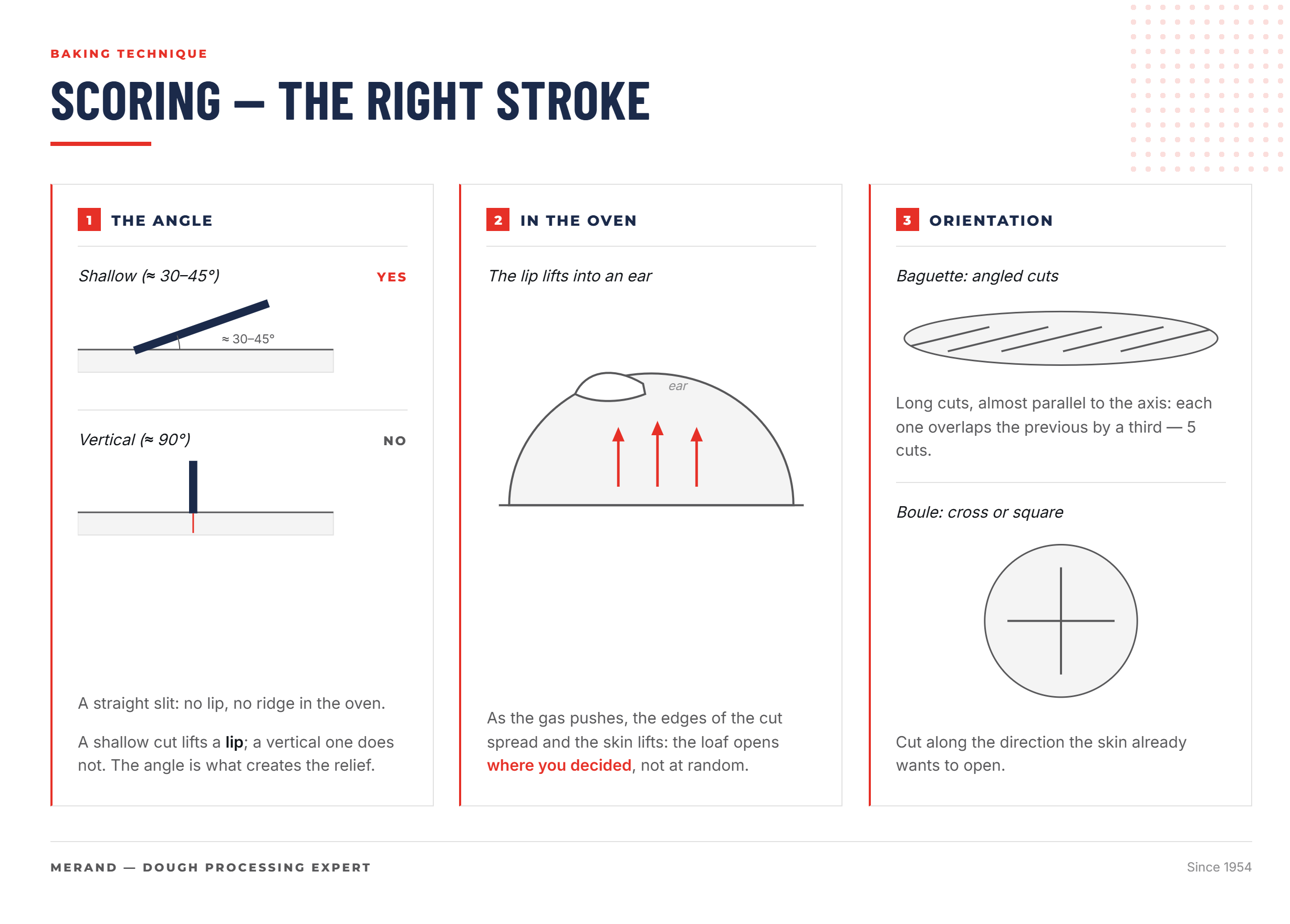
The angle. The blade attacks almost flat (≈ 30-45° to the surface), not vertical. A flat cut lifts a lip that will rise into an ear; a vertical cut merely makes a slit without a ridge. It is the angle that creates the relief.
The depth. Shallow (a few millimeters): you cut the skin, not the crumb. Too deep, you sever the supporting network and the bread collapses; too shallow, the slit doesn't open and the bread tears elsewhere.
The sharpness. The gesture must be clean and quick. A blade that drags sticks to the dough, catches, tears instead of cutting. A very sharp blade, passed in one crisp stroke, slits cleanly without pulling the skin—this is why we use a razor blade (or equivalent), fine and sharp.
The orientation, finally, dialogue with shaping: on a baguette, the cuts are diagonal and overlap slightly, nearly parallel to the axis—this overlap gives regular blistering. On a round loaf, a cross or square distributes the opening. The score extends the direction of tension already inscribed in the skin: you open in the direction the skin already wants to open.
FLAT BLADE + SHALLOW + SHARP → LIFTED LIP → RIDGE (EAR) IN THE OVEN
9 - THE CONNECTION TO EVERYTHING ELSE: The Score Doesn't Lie
The score is merciless: it reveals the state of the dough piece. On under-proofed dough, the overly resistant skin causes the slit to burst into a torn score. On over-proofed dough, the slack skin cannot hold the lip: the slit collapses, no ear. On poorly relaxed dough, the taut surface sticks and catches the blade. And a crusted surface prevents the blade from entering cleanly. Scoring does not create quality, it exposes the quality of the previous steps. A beautiful score is the visible signature of a well-managed process.
✦
"Proofing makes the gas rise; scoring decides where it exits. Between the two, the entire bread is decided, and nothing can be recovered."
PRINCIPLE · THE GAS: RISE, THEN RELEASE
|
Mechanism |
Physicochemical Effect |
Consequence on the Bread |
|---|---|---|
|
Final Proof (fermentation) |
CO2 produced, accumulated in alveoli |
Volume — if skin retains |
|
Retention |
Taut skin + extensible network |
Gas inflates instead of escaping |
|
Tolerance |
Width of the baking window |
Verdict of the entire chain |
|
Temperature / humidity |
Proof speed / skin preserved |
Controlled proof, no crusting |
|
Cold (retarded / frozen) |
Dormant yeasts, active enzymes |
Suppleness, aroma — at the cost of the network |
|
Scoring |
Zone of least resistance oriented |
Controlled opening, directed oven spring |
|
Gesture (angle/depth/sharpness) |
Lifted skin flap |
Clean ear, defined bloom |
TECHNICAL APPLICATION
The Scoring Line® Range
Scoring is the most technical gesture of the entire baking process and the most demanding. The most technical, because the angle, depth, and sharpness decide the score, and the slightest hesitation of the blade tears instead of cuts. The most demanding, because you must repeat it hundreds of times per batch, quickly, accurately, without wavering. This is precisely what mechanization protects: the regularity of an expert gesture, and the health of whoever was doing it by hand.
Expertise Inherited and Deepened
In 2000, MÉRAND acquired the activities of Pan'Eiffel, which had manufactured the automatic scorer Grigne Pain® since 1991. We have continually enriched this offering to make it the Scoring Line® — our full range of automatic scoring solutions for dough pieces before loading into the oven. Once again, mechanizing without betraying: reproducing the ancestral gesture of the baker, with the blade, exactly as it was conceived.
Regularity Makes the Appearance
The score reveals the quality of the entire baking process; its pattern is the signature of the bread. Yet by hand, maintaining the regularity of 6 to 7 diagonal blade strokes per baguette, batch after batch, is extremely difficult. The Grigne Pain® scores with a razor blade—one blade holder per loaf groove, as many blades as cuts to make—which ensures perfect regularity from one dough piece to the next and a beautiful homogeneous appearance across the entire batch. The machine reproduces the diagonal cut (baguettes, half and third baguettes) as well as the straight cut (small loaves).
Mastering a Difficult Gesture, Made Accessible
Because the diagonal cut is technically demanding, automating it makes it reproducible by a non-specialized operator: the only operation consists of introducing the loaf filets into the machine. The expertise is no longer in the wrist; it is in the machine, set once and maintained always. Up to 1,000 blade strokes per minute, with a regularity no hand can sustain over time.
Operator Health, the End of RSI
This is the most human argument, and it weighs heavily. Manual scoring is a permanently bent wrist, hundreds of times per day: the prime path to repetitive strain injuries (RSI), foremost among them carpal tunnel syndrome. By entrusting the repetitive gesture to the machine, the Grigne Pain® eliminates this strain, a healthier workstation, an operator preserved, and expertise that no longer depends on the wear and tear of a wrist.
A Range Adapted to Your Flow
The Grigne Pain® exists in standard version (the operator introduces each loaf filet manually, mobile unit on casters, connected to compressed air) and in conveyor version to integrate into continuous flow. The TopSeeds® option additionally allows seeding the dough pieces (or applying egg wash) in the same motion as scoring. Each configuration adapts to the dimensions of the loaves and the number of blade cuts per product.
✦
The score is the final gesture before the fire, and the most revealing. Mechanizing it is not erasing the baker's hand—it is ensuring its consistency, batch after batch, and protecting the one who was giving it.
✦
« Our machines are designed by bakers, for bakers. »
Come meet us.
We welcome you to our BakingLab® to test our machines. Bring your flour, bring your questions, we'll bring the rest.
Next episode:
Baking & Cooling: Transform and Set
The moment when dough ceases to be dough